Wednesday, March 23, 2011

Berkeley Breathed at the Cartoon Art Museum

Berkeley Breathed. Illustration from Pickles & Pete.
Courtesy Cartoon Art Museum.
In the first volume of the collected Bloom County (IDW), Berkeley Breathed claims that he was destined for a career as a Starbucks barista, that his 1987 Pulitzer Prize was a huge mistake, and that the “accidentally subversive attitude” in his strip was inspired by dead-line pressure and lack of sleep.  He (and the companion essay by Dean Mullaney and Bruce Canwell) reminds of us of what the early 1980’s were like: Ronald Reagan, Johnny Carson, the Star Trek films, Charles and Diana, the hostage crisis, and what wasn’t there, such as the internet as we know it and MTV. There are significant parallels, Mullaney & Canwell point out, between the 1980’s and today (economic problems, trouble in the Middle East, polarized political rhetoric).  At that time, before our attention span was splintered by cable news and the internet, most people, young & old still read newspapers. “It’s fair to state,” Mullaney & Canwell say, “that Bloom County may have well been the last newspaper comic strip to fully capture the nation’s attention.”  This may be true… it certainly had mine; I couldn’t wait to read it every morning. For all his modest posturing, Breathed was a master at getting to the heart of pop culture and human nature.

Berkeley Breathed. Self Portrait.
Courtesy Cartoon Art Museum.
With this context in mind, I went to the Cartoon Art Museum to see Bloom County to Mars: The Imagination of Berkeley Breathed, a selection of key original artworks spanning from the beginning of Bloom County to his recent work as a concept artist for the film Mars Needs Moms. The show is in the main gallery, and seems to be evenly split between black & white drawings for the strip, and color illustrations from his many book & film projects, including his work for Secondhand Lions and Flawed Dogs (one of my personal favorites).

The tone is set by the first work on display, Breathed's “first and last” editorial cartoon for the Austin American Statesman. This 1980 cartoon, Honky Trek: The White Flight perfectly spoofs the famous poster for Star Trek: The Motion Picture, with a trio of middle class Texans taking the place of the Star Trek cast and a truck towing a U-Haul trailer in place of the Enterprise.  If there is any lack in the bounty of this show, it’s the absence of any representative strips from Breathed's early work on The Academia Waltz (for the Daily Texan, the campus newspaper of the University of Texas, Austin). I can’t tell, from reading the commentary in the Bloom County collection if they were in bad condition or Breathed is simply embarrassed by his early work.

Whatever the reason, the viewer loses a chance to see the early development of Breathed’s humor and drawing style, and the first appearances of many of his cast of characters, Steve Dallas, Cutter John, the Hare Krisna guy. What follows are some of Bloom County’s greatest hits:  The Empire Strikes Back spoof, where the cast celebrates the breakup of the Ma Bell monopoly only to sight the Death Star on the horizon (the AT & T globe logo, 7/1/84).  A misunderstanding between Opus and a Sony Walkman wearing woman that results in the line “Godzilla ate Arafat with asparagus on a bun?" (10/31/82). Dialogs with the monster from the closet of anxiety. Gary Trudeau sentenced to hang from chains in the Dungeon of Misbehaving Cartoonists for missing deadlines (8/17/83). A spoof of the (then) ubiquitous audio cassette commercial with Milo getting his hair blown back ala Pete Murphy from Bauhaus (Is it live or is it Memorex? 6/13/83). I had forgotten how topical the strip was, taking on Apartheid and having Bill the Cat woo (or be wooed) by Jeanne Kirkpatrick who sends him a box of chocolates shaped like Nicaragua (85). This section of the exhibit ends, fittingly, with Bill and Opus looking in their underwear to “take a hard look at the thing that brings meaning to men’s lives” (7/25/93)

A 7/31/82 cartoon that introduced Bill the Cat is one place where the viewer is able to really observe and contemplate character development in the strip. Bill is still very cat-like, and is presented as a send-up of Garfield and the overcommodification of that character. Bill is not upright, wearing underwear, or sporting the extremely bug-eyed look we know and love later in the character’s development. Yet, his essential “Bill-ness” is there, you just know there’s something manic-depressive about this cat. After looking at the whole range of the strips on display, I was taken with how the later drawings still had meticulous detail, but the line work grew much more expressive and looser. I suppose Breathed would claim that this was due to lack of sleep. ACK!

The show is rounded out by one or two representative strips from Outland and Opus, and then continues with Breathed’s color work. I found it fascinating to see his technique on these up close, the hard ink lines filled in with soft yet defined highlights and shadows in a watercolor/airbrushed looking style. His use of lighting is excellent. I was mesmerized by the way that this combination of soft and hard, light and shadow led my eye through the painting.  On the whole, I’d say we are lucky that Starbucks missed out on a promising barista, and Breathed pursued another career.

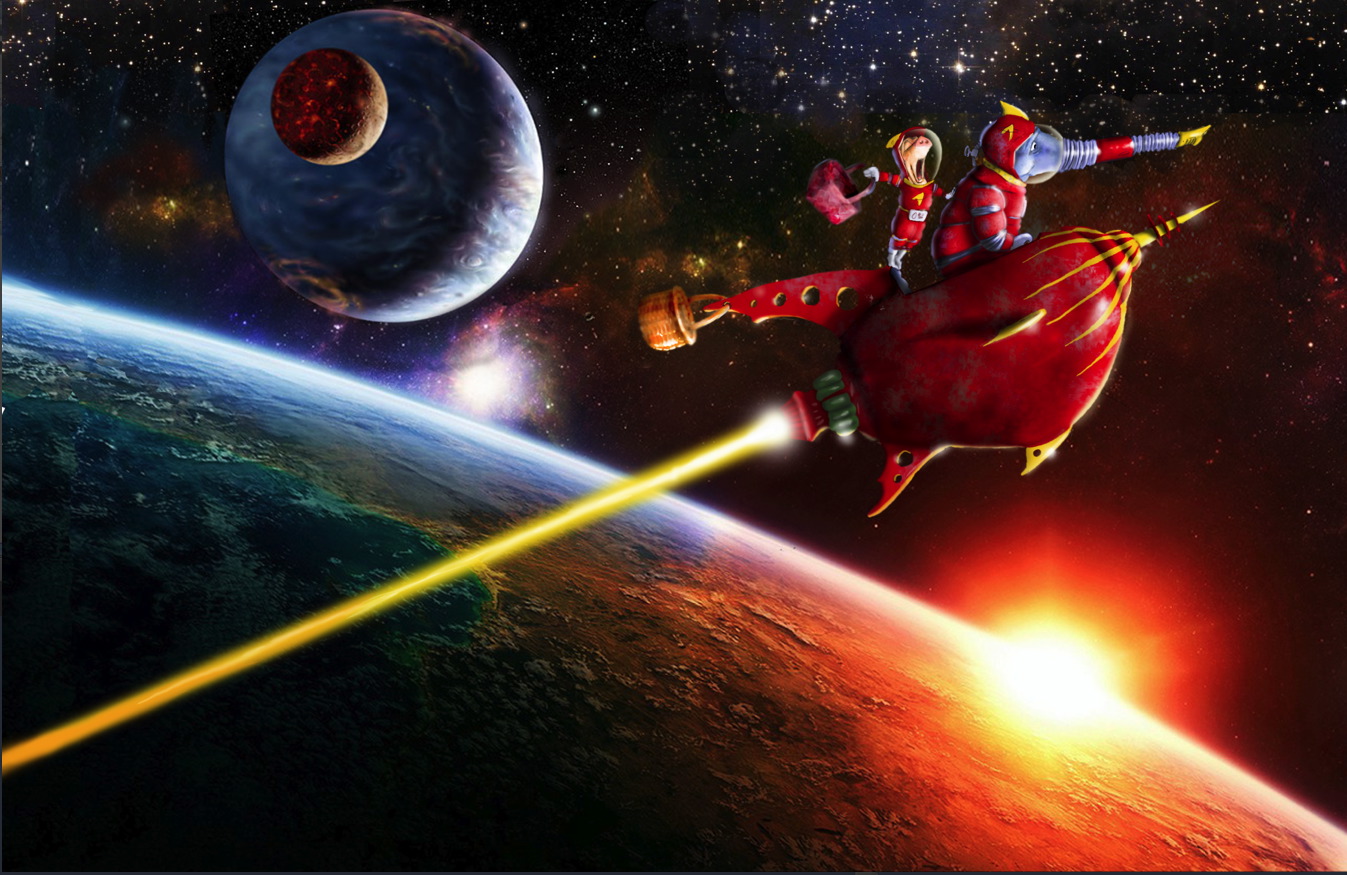
Berkeley Breathed. Concept art from Mars Needs Moms.
Courtesy Cartoon Art Museum.
Breathed is a special guest at WonderCon this year, with a spotlight session on Saturday. IDW is sponsoring a silent auction and reception for Breathed to benefit the Cartoon Art Museum and the Hero Initiative at the museum Saturday, April 2 from 8pm to 11pm (sliding scale).

Saturday, March 5, 2011

Eisner, Jefferson & the City

MoCCA poster

Will Eisner’s New York: From The Spirit to the Modern Graphic Novel (March 1- June 30th 2011) . MoCCA NY,Curated by Denis Kitchen and Danny Fingeroth.

To Eisner's famous 1940's superhero The Spirit, Central City (a thinly veiled version of New York) was as much a character as any of the humans portrayed. The hero, Denny Colt thought of the city almost as a lover, a nurturing entity that would provide for his needs, even though it was clear that there were villains lurking in the shadows. The life force of New York became even more of a focus when Eisner, inspired by the uncensored and often autobiographical work of the underground cartoonists, leaped into autobiography himself in 1978 with A Contract With God. With this book, Eisner reinvented his career, and in the process became one of the pioneers that helped shape the graphic novel.

Eisner's work is often moody and atmospheric. The emotional landscape of his characters are defined by the sun, the rain, the wind, and the mood on the street. The work is filled with lush historical landscapes and gritty urban neighborhoods. The Dropsie Avenue (Bronx) saga tells the story of how the lives of several generations are shaped by their environment between 1870 and the 1990's.  Eisner begins and ends the story with idealized landscapes- farms & gardens, but the beauty found there is always interrupted by the highs and lows of the people who live there. As the story follows the lives in the neighborhood from farm to high class home to slum, crack house and back to the garden again, Eisner's view changes from wide open spaces to dark, narrow streets and interiors. Even though the neighborhood returns to affordable housing and a community garden at the end, it's clear that it won't last for long.

Eisner doesn't take the contrast to the extreme some authors do, but this idea of the idealized, pure country and the demonization of the dark, evil city has been on my mind lately. In real life, good and bad both happen everywhere, yet there's the myth of the wise, happy rural countryside.  It's an idea that has been with us since the parable of the country mouse and the city mouse in Aesop's Fables, but it seems like a myth that holds a strong attraction for many Americans. Even the "Happy Cows of California" milk commercials have their roots in this concept.

Jeffery K. Johnson suggests that this idea of the idealized rural life may have taken hold through the writings of Thomas Jefferson and his concept of the yeoman farmer.  In Johnson's article The Countryside Triumphant: Jefferson's Ideal of Rural Superiority and the Modern Superhero Mythology (2010), he describes Jefferson's almost Apocalyptic disgust with the industrial centers of Europe and his belief in the virtues of a rural landscape populated by wise gentleman farmers.  Johnson points out the many ways that this notion has been enshrined in popular culture, and ultimately uses the contrasting examples of Superman and Batman to make his point. Batman lives in the dark shadows of Gotham City, driven by the idea of indirectly avenging his parent's murder in a dark alley. Superman's positive outlook is formed by the home-spun values instilled in him by his adopted parents, the Kents, and he seems to carry an idealized Kansas within him, no matter how dark things seem.

It's this subtext, the yeoman farmer myth, that Eisner masterfully plays with and against in his characterization of the life cycle of a Bronx neighborhood. The young bride who ultimately returns to save the neighborhood, is given 2 acres of land in Winchester for a garden/farm as her wedding gift.  As the neighborhood grows darker and more violent over time, the contrast with the idealized "other place" outside of the city is always under the surface. Only New York provides a canvas big enough to fully explore the dramatic lives of Eisner's characters.

In The Mood by Jules Feiffer, 2011
The MoCCA show will include much of Eisner's autobiographical work, and will be enhanced by a companion show that displays work by artists influenced by Eisner, including Neal Adams, Sergio Aragones, Terry Beatty, Nick Cardy, Darwyn Cooke, Eric Drooker, Jules Feiffer, Michael T. Gilbert, Dean Haspiel, Al Jaffee, Klaus Janson, Jack Kirby, Denis Kitchen, Joe Kubert, Peter Kuper, Harvey Kurtzman, Batton Lash, Steve Leialoha, Michael Avon Oeming, Peter Poplaski, Joe Quesada, Paul Rivoche, Trina Robbins, Jerry Robinson, Stan Sakai, Mark Schultz R. Sikoryak, Art Spiegelman, Wally Wood and Steve Ditko..

Comics in ArtNews

While checking out the March issue of ArtNews this morning (the photography issue), I was pleasantly surprised to see a couple of short reviews of comics.  Even though comic art has slowly worked its way into the museum world, I am painfully aware that it still has a long way to go.  It was nice to see mention of these graphic novels in ArtNews, a mainstream art magazine who would have never thought comics worth mentioning ten years ago.

The art world, ever narcissistic, prefers to hear about comics that mirror and comment on the concerns, habits and stereotypical people found in museums and art world culture. It seems almost myopic in the case of  The Cardboard Valise, the first book published in ten years by Ben Katchor,which is really about the much larger topic of society’s attitudes about diversity and world culture. Katchor’s black & white, edgy people populate a vast landscape of familiar yet imaginary cities.  When the main character visits a museum (this is the section the review focuses on), Katchor tells us “not to take cultural artifacts too seriously,” by showing us a panel of a young curator from the “Museum of Accidental Art” who insists on taking the character’s pants because they have the “perfect disposition of napkin lint on navy-blue pants; they must be purchased by the state, but belong to posterity.” The ArtNews review is not on-line at this time, but you can see Katchor’s work here & here. Design-wise, I also think it's perfect that the book actually comes in the form of a cardboard valise.
The second book featured is Pablo Helguera's Artoons 3, the latest in a series that lampoons pretty much everything about the art world and museum culture.  Helguera works in the education department of MoMA, and I enjoy his inside view of things. In one panel he shows an archeologist scrutinizing a stone tablet, who turns to his assistant and says "The text is incomprehensible... it must an exhibition catalogue."   He also created a very funny spoof of the classic Chicago Style Manual called The Paulo Helguera Manual of Contemporary Art Style. Hellguera also has an active and cartoon filled page dedicated to his Artoons on facebook.

Erro. The Tank Girl is behind him.
Also of interest to comics fans are two full page ads by the gallery representing the Icelandic artist Erro, who has been controversial for his too-close-for comfort appropriation of one of Brian Bolland's Tank Girl covers, and an exhibition review of two shows that explore Hello Kitty, and the Japanese craze for the kawaii (cute) esthetic.

Monday, January 17, 2011

Specs & Literary North Beach

It’s 5:30 on a weekday, shortly after the holidays, and I’m sitting at the bar at Specs Twelve Adler Museum Café, which is situated on an odd mini-cul-de-sac in North Beach, about half a block off Columbus between Broadway and Kearny.  Specs is one of those urban landmarks that has transcended its primary purpose as a dive bar due to its history and constituency, becoming a nexus of interrelated social structures and narratives.  Crammed from floor to ceiling with signs and memorabilia, Specs Bar is part of a “rectangle” of businesses that have retained their Bohemian/artist-poet/anarchist roots.  Across the small courtyard is the more upscale Tosca Restaurant. The venerable City Lights bookstore and the Vesuvio Café, directly across Columbus Avenue, complete the rectangle. About 2 blocks away is the Beat Museum, with its own bookstore, another commemoration of the history of “Literary North Beach.”

I'm thinking about handwritten communication, and why people don't write anymore.  Denise, a fellow art historian, is interested in exploring this topic, and possibly doing an exhibition about it. I'm thinking about it because I heard somewhere that the US postal service might close in next 5 years because people get nothing but junk mail and bills, and no one sends personal mail anymore. I think I'm guilty myself. I've spent so much time typing that my own handwriting has even become illegible to me. Yet North Beach, home of the great Beat poets & novelists, is still fertile ground for the written word.  I sip my (very strong) drink, and get out my notebook, needing to perform the physical activity of writing.

View in front of Specs.
Photo by Kim
A block to the East and a world away, the residents of Chinatown are closing their shops for the day.  Although the stories of Italian immigrants, Longshoremen and Beat poets live on at Specs, you’d never know that blood-drenched race riots happened in this neighborhood during the late 1800’s.  Unemployed white and immigrant workers, blaming (usually horribly exploited) Chinese labor for stealing their jobs, frequently ran violently amok, killing many.  While Kearney Street is said by some sources to be named for someone other than Dennis Kearny, it still seems a strange coincidence that Kearny Street is the Southern boundary line of Chinatown. Dennis Kearney, as the leader of the Workingman’s Party, led many of the afore mentioned riots and gained a brief hold on political power in the 1870’s.  He was instrumental in the enactment of much anti-Chinese labor legislation.  There are still economic border skirmishes in the neighborhood, but these days the behavior between factions is non-violent and politically correct.

The history on the walls at Specs picks up in about 1940.  There are signs and posters from World War Two, paintings and framed poems by neighborhood artists, and autographed photos of strippers that used to work upstairs at the Garden of Eden nightclub (in the 1960’s Specs and the Garden had a hidden adjoining door).  Specs connection to the maritime industries is evident in its “décor;” over the years Merchant Marines and Longshoremen brought strange artifacts from all over the world, which cover the walls and ceiling and fill the display cases to overflowing.  Hanging in front of me over the bar is a somewhat faded IWW banner (“One Big Union”), a subtle reminder that Specs was the first union bar in North Beach.  Over my head, I can see the Welsh flag, the jawbones of a great white shark, a stuffed pufferfish with about 6 inches of dust, and a sign that says “all dogs will be eaten.”

It’s quiet today, so the dogs and dust mites are safe.  There are two people murmuring to each other about movies at the end of the bar, a trio of tourists behind me squinting at a guide book, and a couple of guys that work at Vesuvio’s taking a break at one of the back tables. In the corner a businessman in a rumpled suit is absorbed in his beer and the Wall Street Journal.

As I’ve been nursing my drink, writing, and reading the New Yorker, I’ve been thinking about Lefebvre’s concept of “spacial practice.” I’ve been dropping into Specs occasionally since I moved to San Francisco in the late 1980’s.  Aside from being an interesting place for a drink and conversation, for decades the space has hosted figure drawing groups, open mic poetry readings, and is completely given over to the neighborhood once a year for a community pot luck.  Having observed how the community uses the space over the years, it’s clear that the employees and patrons at Specs have a tacit code of conduct. Specs has become more than a bar, it’s a community space, and the people that share the space expect you to mind the rules.

People get really drunk at Specs, yet they will be “86’ed” (thrown out) if they get loud or do anything obnoxious.  My favorite bartender back in the 90’s, Kent McCarthy, was a gentle giant, an ex-Hells Angel who loved a good time but got deeply offended by bad behavior in “his” bar.  This paternal attitude has continued.  I have never seen any type of waitress or server at Specs; the bartender’s judgment is final (like they are the Captains of the ship).  They are supplied with a selection of cards saying things like “Sir, the lady is not interested in your company…,” “Madam, the gentleman prefers to sulk in silence …,” or the “unfit to drink” sign, which appears if the drink you order seems too frilly (or too “girly,” a lot of this code is still based in 1950’s male working class ideals).   The bartenders are also the first to chat the customers up, providing the initial clues to the expected code of social behavior. Kent’s place is taken today by Lucy, a strong and wonderful woman who is generous with both the Vodka and her good humor.

Photo from SF Bar Experiment Blog
I’ve also noticed that there’s a sort of a hierarchy of space that governs where people sit.  Neighborhood locals usually sit at the bar or the two back tables.  Semi-regulars from the financial district tend to be in groups of three or four and sit at the tables closest to the door.  The “Bridge and Tunnel” people and tourists gradually fill out the middle of the space.  No one hands out a seating chart at the door, yet people instinctively have sat this way for as long as I can remember.

The patrons sitting at the bar seem to form a separate community from the table-sitters.  The bar-sitters usually want to talk about politics, the neighborhood, art or some of the eccentric characters we remember.  For example, in the early 1990’s there was a hippy-ish lady that used come in almost every day and hit up the customers for handwriting analysis.  She was never an employee, yet later she billed the owner for thousands of dollars in “back wages.”  Another regular I remember would come in with a backpack containing his two pet bunnies, which would hop around in the inset of the small front window while he talked politics and drank his beer.  Various radical political groups used the back tables as their weekly meeting spot, getting so heated at times that everyone in the bar would stop their other conversations and listen.  These might be thought of as transgressive behaviors in other places, but at Specs this was everyday life.

A different view of community life was apparent on Sunday afternoons, when Specs hosted the figure drawing group. Although the group seems to be “taking a break” at the moment, Specs donated space to a figure drawing class for decades. No alcohol is served and the bar itself is closed to the public.  A place would be cleared and lit for the model, while 5 to 10 earnest artists (mostly recent SFAI grads) gamely tried to capture her pose.  Drawing at Specs was fun, yet it’s a challenging environment.  There were no easels or equipment of any type supplied, except for the tables used in the bar, and it’s was really dark in the room – an odd environment for a drawing class.  The only lighting aside from the spot on the model was dim and yellow, so it’s hard to see your work.  Nobody seemed to mind this.  We all seemed very content, feverishly drawing away in the dark while listening to blues or jazz on the stereo.  Eventually, we would stand outside blinking in the sunlight, shocked whenever whatever we drew in that dark cave came out looking like a human figure.

Is the "Dream" in Pittsburgh?
Getting back to the idea of handwritten communication, when you sit at the bar at Specs you can look though plastic baskets filled with postcards that bar patrons have sent in from all over the world.  This has been going on since the bar opened in 1968, and thousands of random dog-eared postcards that range in sentiment from deep philosophy to “wish you were here” are there to be pondered. One regular patron who traveled the US widely used to send a card on the theme of “looking for the American Dream” from everywhere he went.  Alas, it was always elusive. It was never where it was supposed to be (perhaps in Pittsburgh, in the example to the left). The Dream would be rumored to be in the next town or the next state.  Eventually other “dreamers” started to mimic this patron, sending cards of their own, but none of them seemed to have the same style or philosophical bent.  How interesting it is, that even now, when people are really out of the habit of sending postcards (or handwritten communication of any kind), people still send postcards to Specs.

The ways that all these people and their individual narratives interact in the space of Specs has always fascinated me.  It’s just a bar, yet it’s not.  The owner, the employees and the patrons have managed to cultivate a very specific type of culture (which greatly values Lefebvre’s “representational spaces”).  Casual, Bohemian, traditional, artistic, seedy, yet somehow respectful, and oddly confident that everyone is capable of good behavior (or else... the dreaded 86), Specs is one of those spaces that make San Francisco unique.

The Language of Birds. Photo by Kim.
A block away, in front of the Jazz mural at Columbus and Broadway, is a public art installation by Brian Goggin and Dorka Keehn that also references “Literary North Beach.” The Language of Birds uses the metaphor of a flock of flying books to explore the literary history of the neighborhood.  The artists note that mythologically, birds were thought to speak a divine language that was understood by the initiated (I’m pretty sure the birds in my neighborhood are simply obsessed with peanuts and bird seed, but who knows). The piece is very striking when lit in the evening, and it’s fun to read the phrases on the sidewalk below.

More about Specs:  Specs birthday | SF Chronicle profile | bartenders & postcards. More about the Language of Birds: SFAC | SF Chronicle
Sunday, November 28, 2010

Could There Money in Walking Eyeballs?

I’ve been a doodler my whole life. My notes from classes & business meetings, phone messages & grocery lists are usually adorned by horsies with windblown mane, smiling suns with complicated rays, ornately framed words and eyeballs with feet (sometimes smoking a cigarette like a French eyeball á la Rick Griffin). Sometimes I sketch people or objects in the room, draw imaginary flower arrangements, or draw portraits of my friends Archie style.

Chief Doodler Michael Lopez demos.
Lea Suzuki / The Chronicle
It’s been interesting to see doodles, which have long seemed to be an unnoticed solitary activity, start to appear in the news. I’ve been talking a lot with Denis Kitchen about his soon-to-be released book of his own doodles, Denis Kitchen’s Chipboard Sketchbook, with all of his surreal characters and wacky animals. Cartoonist Lynda Barry recently told NPR about how doodling helps her through writer’s block (personally I get carried away and keep drawing). Now, on the front page of the print edition of the Sunday SF Chronicle, we have a feature article on “the doodlers of Google” who draw all those cartoons on the Google home page.  It’s an interesting story about how the idea of these doodles came about, and how the doodles help Google seem more personal and connected to the millions of people who use the site. Chief Doodler for Google! A real job! Maybe there’s hope for making real money in the arts yet…

Still, more than the mythical high paying art job, is the fascination with doodles themselves. Why do we do it? Why do so many people find it relaxing to draw funny animals? Most people will tell you that it’s a subconscious, unplanned process. They put pencil/pen to paper, start a line and discover the drawing as it happens. I think we, the viewers, are intrigued by the mental process these drawings reveal, or maybe we just enjoy the looseness and spontaneity of them, a peek into the artist’s unguarded mind. I guess no matter how focused we get on staring at glowing screens, we still have an urgent need to express ourselves with our hands by creating something.

Wednesday, November 24, 2010

Mark Bodé, Part 3 on Comics Journal Blog

Left: Christophe Blanc, Je suis la fin ces haricots, serigraph, 62 x 40 cm, ©2009 Christophe Blanc.Right: Poster for Mark’s next show, Monterey Pop Art in January, 2011.
Third and final installment of my interview with Mark Bodé on the Comics Journal blog.

Monday, November 22, 2010

Mark Bode, Part 2 on Comics Journal Blog

Cobalt 60 ©1984 Barbara and Mark Bodé.
Part two of my interview with Mark Bodé has been posted on the Comics Journal blog.