Saturday, July 28, 2012

Comic Arts Conference Wrap-up SDCC 2012

One of the most amazing things about San Diego Comic-Con is that it contains more universes than that bag of marbles at the end of Men in Black.  There are so many different communities getting together that it would be just about impossible to touch on all of them. I’ll never forget the year that I went into a room early to catch a spotlight on J J Sedelmaier, and found myself in the middle of the Klingon Lifestyle Presentation, an annual drama featuring the crew of the IKV Stranglehold. It was so cool! And great costumes!

Anyway, not so many costumes at the Comic Arts Conference, the comics scholarship conference that celebrated its 20th anniversary at this year’s convention. The instigators, Peter Coogan and Randy Duncan  (still co-chairs and active participants) were awarded the Inkpot this year in commemoration of this feat.  The CAC room is like a sea of tranquility in the midst of a hurricane of craziness, and I am constantly slipping in & out of the room while the festivities are going on. You never know who you will see; comics professionals, independent scholars you never see anywhere else, professors from around the world, students & young scholars presenting for the first time … it’s a great experience.

The first CAC panel kicked things off with Subaltern Counterculture and Strengths of the Underdog, a group that opened my eyes to all kinds of viewpoints I hadn’t thought of. These included Crisis on Indigenous Earth: Comic Art Indigene Mateo Romero and Antonio Chavarria (Museum of the Indian Arts & Culture); Mexico City as the Field of Signification: Creating a Subaltern Hero in Daniel Munoz’s El Pantera Sam Cannon (U of Texas, Austin); Cyber-Blackness and the Ethics of De-Racialized Characters Kane Anderson (UC Santa Barbara) and Rebel Yell: The Physical and Racial Identity of Storm Ayanna Dozier (Chapman University). This last one, with her discussion of the “bad girl” punk version of Storm, really set me up for the next panel I was going to, CBLDF’s forum on women’s issues in comics.

I caught a number of great presentations on Friday, beginning with a humorous and provocative look at US comics from the Canadian perspective (it’s not all about you, USA) called “So that’s what an angry Canadian sounds like!” Fan Responses to Alpha Flight by Amanda Murphyao (Carleton University). Following her was the Revolution & Reaction panel, kicked off by the always amazing Trina Robbins (Lily Renée, Escape Artist) talking about her recent research on the art and life of Holocaust survivor Lily Renée Wilheim, one of the most successful women cartoonists during World War II and Fiction House's only woman cartoonist to draw covers as well as interior stories.  The rest of the panel was also interesting with a theoretical look at McCay, UM-CHOW: Winsor McCay’s Political Object Relations Eyal Amiran (UC Irvine); Make Way for the Fat Fury: Herbie and the Postwar Consumer Matt Yockey (U of Toledo) and a fascinating look at the comic-book-style evangelical tracts of Jack T. Chick by Cori Knight and Sean Sagan (UC Irvine).

Lily Renee. A great story by Trina Robbins
Following this were two important panels on Kirby. I’m sorry to say that I missed the first one, Jack Kirby and the Auteur Theory of Comics with Arlen Schumer & Randolph Hoppe (Kirby Museum) joined by Kirby scholars John Morrow (The Jack Kirby Collector); Charles Hatfield (Eisner Winner!) and Craig Fischer (Appalachian State University). I am happy to say that the whole thing was caught on video, and has been posted on Comics Journal for your viewing pleasure. Schumer’s article is also included in the current International Journal of Comic Art (Spring 2012), along with a rebuttal by Barry Pearl.

As regular readers of this blog might know, I have long been interested in researching and writing about Jack Kirby’s collages, so the next panel Jack Kirby, Modernism & Abstraction turned out to be one of the most exciting panels I witnessed at the Con. Andrei Molotiu (Indiana University; Abstract Comics Anthology & blog) and Mark Badger (Batman: Jazz, Martian Manhunter) succeeded in tying Kirby’s work not only into works I’ve written about before (Richard Hamilton, Hanna Hoch) but also Modernist masters like Wassily Kandinsky, Franz Kline, Lyubouv Popova and the theories of Clement Greenberg. It might not seem like it works, looking at this tiny picture of a Kline on my blog, but when you see Kirby's vibrant work and these dynamic paintings side by side on a big screen, it's a really strong argument.

Franz Kline (American, 1910-1962). Mahoning, 1956. Oil and paper collage on canvas.
80 x 100 in. (203.2 x 254 cm). Purchase, with funds from the Friends of the
Whitney Museum of American Art. Whitney Museum of American Art, New York.
© 2009 The Franz Kline Estate/Artists Rights Society (ARS), New York
Saturday brought us a visit from John Lent (publisher of the IJOCA, and more books on international comics than I can name) who came to speak in San Diego as a sort of detour between Malaysia and a conference in South Africa (bet some airline owes him A LOT of miles).  The Pioneers of Comics Scholarship panel, moderated by Randy Duncan (Eisner nominee!), included Lent, David Kunzle (History of the Comics Strip), Vicki Green (The Indian in the Western Comic Book) and Joseph Witek (Comic Books as History, editor of the Conversations series for U of Mississippi Press). It was great to hear the stories of how they all started researching comics, how they overcame discouragement, and where they thought scholarship was going in the future.

Following this was an interesting trio of papers on the ideas of economics, ideology and politics in the writings of Grant Morrison by Marc Singer (Howard University); Jason Tondro (UC Riverside) and Karma Waltonen (UC Davis). Singer’s presentation, Morrison, Incorporated was particularly interesting because he collected together several storylines where Morrison made corporations a villain, or even an actual character, and I thought it was a good commentary on the Occupy movement and the financial crisis we find ourselves in. I also enjoyed Jade Hidle's (UC San Diego) presentation on comics exploring the Vietnamese view of the US/Vietnam War experience. In one of those "only at SDCC" type stories, she's a local girl and long-time Con attendee, there to present for the first time with her Dad in the audience, who finds that the writer/artist she wrote about, Eisner nominee GB Tran, was there and wanted to sit in on the panel, and it was moderated by Scott McCloud (Understanding Comics) who she cited extensively. I was so happy for this girl, and she did a great job.

My husband Marc and I couldn’t help comparing the Pioneers panel with the panel that closed the conference, a presentation of field studies by students that were looking at the culture of comic-con (organized by Matthew J. Smith, Eisner nominee!). Many of them were Con virgins, and it was interesting to hear their responses to fan culture, endless lines, getting into Hall H, mega-marketing, etc.  Stephen Cunningham (U of Central Arkansas) commented that it was the first time he’d ever been to a Con, and the first time he’d ever been to California, and he was shocked how nice people at the Con were in comparison to people attending a Razorbacks game. As I listened to the response from the audience (“oh, you didn’t see this person push me”… “oh, this line was terrible”), I was thinking to myself, “Boy… you people have never been to a Raiders game have you?” People at Comic-Con, with all 120,000 (plus) of us jammed in together do actually try to be mellow and get along. We are all happy to be there, with our peeps, in the one place all of our separate universes collide.

A Raiders fan in the Black Hole. Who knows? Maybe
he comes to SDCC dressed as Skeletor...

Friday, July 27, 2012

Sherman, Nottebohm & Clerque in SF

Saw the Cindy Sherman (born January 19, 1954 in Glen Ridge, New Jersey) retrospective at SFMOMA yesterday. Although it was laid out more or less chronologically, I viewed it backwards (as usual) seeing her most recent work, the Society Portrait series first. These ¾ to full body heroic scale portraits were stunning. I'm sure I’ve seen all the women she is referencing, old money; the aging trophy wife; the philanthropist; the New Yorker with terrible teeth and a bad dye job. As a female person of middle age, I recognized the struggle of these characters beneath the glossy surface, trying in vain to hang on to beauty & status.  I also couldn’t help thinking about Renaissance female portraits and the the abundant symbolism employed in them to tell the viewer about the good qualities and status of the sitter, with the obvious symbols of wealth and taste like diamonds and Hermès scarves standing in for pearls, rubies, and the other traditional signifiers of purity & devotion.

Cindy Sherman, Untitled #465, 2008;
chromogenic color print; 63 3/4 x 57 1/4" (161.9 x 145.4 cm);
courtesy the artist and Metro Pictures, New York; © 2012 Cindy Sherman

Source: http://www.sfmoma.org/about/press/images/919#ixzz21nrrFQcE
San Francisco Museum of Modern Art
This left me in the perfect frame of mind to view Sherman’s History series, in which she parodies the styles and motifs often seen in classical European painting. These works, with their exaggerated prosthetics and deft manipulation of the subject matter, consider changing artistic processes, social mores and gender roles in Western society.  The giant noses, bellies and breasts make an interesting commentary on the changing meanings of words like “sexy” and “desirable” from one era to another (good article on these here). Seeing these very theatrical portraits juxtaposed with the raw vulnerability of the Centerfolds series in the next gallery was a breathtaking contrast. I finished at the beginning, with the photos that first brought Sherman to prominence, the Film Stills. It was great to see these all together in order. I was lucky to be there on a weekday, and there was space to step back and see entire series as a composition. They have a rhythm together that you would never get looking at them individually in a book. Comparing these with her newest work (the Society Portraits in the next gallery), I felt that the artist has great awareness of humanity & inner life, as seen through the lens of the culture she skewers so well.

Andreas Nottebohm. AN-2001, May 2012, oil on aluminum 29 x 48" at Modernism

Around the corner from SFMOMA, I stopped in at Modernism, where the works of Andreas Nottebohm (born 1944, Eisenach, East Germany) and Lucien Clergue (born 1934, Arles, France) are on display. While Sherman’s work delves into the inner life of her characters, these works are lovely and very much about the surface. Nottebohm distresses the surface of aluminum panels with power tools, and then paints them with glazes of oil. They have a luminescent holographic quality that has to be seen to be believed. The most interesting (to me) of Clergue’s photographic works were a series of female nudes striped by the shadows of venetian blinds.

Lucien Clergue. Zebra Nude, 1997. gelatin silver print, at Modernism.
 Nottebohm and Clergue are at Modernism on Market Street July 11 - August 25, 2012.  Cindy Sherman is at SFMOMA July 14th - October 8, 2012

Tuesday, July 24, 2012

San Diego Comic-Con 2012 Photos

Getting caught up from SDCC. Another overwhelming and amazing con. Great panels, friends, announcements, books and toys! More posts to come.

If you can't see this slideshow, click here to see it on Flickr.

Friday, July 20, 2012

Ceramic Artist Emil Yanos


Emil's design for the Kitayama Cup
competition.
Today's interview is with Emil Yanos, AIFD; ceramic artist, florist and all around amazingly creative guy. I visited his ceramics studio not long after we both participated in the Kitayama Cup Floral Design Competition.

KM: Thanks for having me over to your studio. It was fun to see you at the Kitayama Cup competition. I was really surprised that you didn't win! There was a big AIFD presence. You are the outgoing president. Can you talk a little about the AIFD? Everyone seems friendly.

EY: Yes, I'm the outgoing president of AIFD Northwest.  If you don't know AIFD is a professional floral organization whose purpose is to promote design excellence, floral education and professionalism in the floral industry.  We try to put on programs that educate the public as well as our current members.  Subject could range from design techniques to shop practices.  Of course we want to promote people in our region.

Emil at his studio.
KM: Well, I love flowers, but I'm really intrigued by your ceramics. You tell me that the floral designs and the ceramics are really separate disciplines to you, but I see lots of organic forms here, especially this cone-shaped series you are working on now.

EY: I really see flowers and ceramics as separate entities.  I'm not saying that either can't be incorporated together.  I would like each to be able to stand on its own.  I have made containers for flowers.  The aesthetic for those were determined by function.  Of course you can put flowers in my other work but their primary function is art.

In general my work deals with texture and contrast.  You can see a juxtaposition of rough with smooth, shiny with matte, and everything in between.  In many cases, color is kept to a minimum because there is so much visual interest.  At the same time I occasionally will add a vibrant color when I feel the piece needs it.

Ceramic candle holders by Emil Yanos
KM: Can you talk a little about these Illuminations candle holders? I love the texture of these, rough on the outside and smooth and shiney on the inside. Another interviewer commented that they reminded her of lava, personally I'm a big sci-fi fan, so they look like dinosaur eggs to me. What was your real inspiration?

EY: Its funny my votives remind you of dinosaur eggs.  Thats what they remind me of.  If you go to my ceramic page on Facebook, you'll notice the photo I use.  I had those pieces shot with eggs.  To me its kind of like an egg fossil.  As I told you, my objective was to work within my capabilities.  When I first started doing ceramics, my pinch pots (which is what these are) did not retain moisture, they became dried and cracked.  I decided to use that feature to my advantage, instead of working against it.  It comes down to knowing you skill and materials and how to use each to its full potential.

Large "coconut bowl" by Emil Yanos
KM: I love these bowls and platters made of strips. You told me an interesting story about these.

EY: I began making the "Coconut" bowls when I developed tendonitis and I couldn't thow.  Making coils was the only thing I could do without injuring myself any further.  The coils are pressed into a form then smoothed out.  I wanted to high light the exterior so I decided to put on a wash of iron oxide, which fires to a warm toasty brown, and keep the "color" on the interior.  When they came out of the kiln they reminded me of coconuts.


Two photos of works from Emil's Maui series.
KM: You told me that you've had a space here at Ruby's Clay Studio for a long time, and that a different artist's work is shown in the upstairs gallery every couple of weeks. Do you have one coming up soon?

EY: Ruby's has a new show every two weeks.  I was part of the Open Studio show last October.  Every October San Francisco has its open studios.  I participated in open studios the last two or three years, featuring my latest work, the Maui series.  This is the series that was inspired by the back of leaves.  I've used used this inspiration and transformed it into the varying shapes.

There is a great interview with Emil on the Handful of Salt design blog, and you can see the wide range of his ceramic work on his web site limegreen.


If you can't see the slideshow above, click here to see it on Flickr.

Friday, June 15, 2012

Sigur on Japan, Decorative Arts & Art History

Hannah Sigur
KM: This is a conversation with Hannah Sigur, an art historian who recently presented on the Japanese influence on American decorative arts at the Legion of Honor in conjunction with the Cult of Beauty exhibition. Hannah, would you mind repeating your story of the Japonesque room you discovered (re-discovered) recently? I love stories about discovery through research and serendipity.

HS: It was the Japonesque parlor of Henry Marquand, first president of the Metropolitan Museum of Art. The mansion, by Richard Morris Hunt, the most famous architect of the era, and its Japonesque room, were considered major highlights at the time, and there was much hand-wringing when the property was sold and mansion demolished shortly after his death. His famous art collection, he intended for the Met, was sold; the "Japanese room" disappeared. About 6 weeks ago, a good friend who is a well known glass conservator was brought in by an appraiser for a project at a 1905 house in Connecticut being prepared for sale. They found remnants of what had once been a stunning Japonesque interior and some unidentified period photos and wondered if it was Jeckyll. She sent me those, and her own photos of details and asked what I thought. I said it didn't look like Jeckyll. But, quick research on the owner of the 1905 house showed that he had been very significant in his day, and casting about for the kind of social circles he might have been in, I remembered the Marquand mansion and sent her a period NYT article about it, which had rudimentary photo reproductions of the Japonesque interior. They matched the original photos exactly. So we have found the long lost room. But it is in such reduced state, and because it is up for sale, it's hard to know what might unfold with whoever the new owners turn out to be. The designer, Manley Cutter, fell rapidly into obscurity after this remarkable debut and finding out much about him is for the moment elusive. But I think it's an important find because of its quality and because it gives a sense of what these now largely lost rooms were like. And, maybe with Cutter we'll uncover something interesting.

KM: This event was hosted by the American Decorative Arts Forum. I recognized many people there from Victorian Society of America events, and other things we’ve attended together. I have to admit that before this I didn’t realize what an active community of collectors there are in the bay area.

Hannah utilizing a group of wallpapers to illustrate the cross-pollination
of design elements between Japan, the US, and Europe.
HS: The ADAF is as good as it gets in the Bay Area--it encompasses very wide ranging interests and it seems to be very well-run, and it has a lot of very smart, friendly members. I've been to several of their lectures, and all were well attended, although mine was exceptional--I think because Cult of Beauty is so gorgeous. They also benefit from some sort of official relationship with FAMSF, although my impression is that the museum administration and curators aren't necessarily attuned to what an excellent asset the ADAF is to them. ADAF had asked if I would do a gallery walk-through, for example, and the curators turned it down. At the Met, or any other major museum, they would have jumped to have a specialist for something like that. The museum should be requiring that their docents all attend ADAF lectures--they bring people in from all over the country, so it was quite an honor for me to be invited to speak.

KM: Often when we talk about local museum exhibits with Asian art connections, you tell me that you feel things have been misstated or misunderstood. What questions should we keep in mind while looking at these shows?

HS: That's a tricky question. At the FAMSF and SFMoMa, the curators seem to have little real knowledge or deep interest in Asian material culture, and if you're going to reference it, you need to be accurate and up-to-date. But they are not motivated to do it on their own, and because there is no mentality of collaboration with the academic community here, they do not ask them or involve them in any way. This leaves major gaps. It was not rocket science to see the Japanese elements in the "Iznik" dish, and that dish became much more expressive of Aesthetic philosophy by revealing them. There were other issues--the Hokusai reference for the Godwin cabinet was doubly wrong. If the curator had mentioned the other artist, it would have been acceptable because it's a much more recent assessment, from a Japanese scholar who had recently published a significant book in English on the Japonesque in Britain.  At the Asian, it seems to be a slightly different problem--leaving out things because of the presumption that people do not need or want to know--thus preserving the sense of exoticism and exclusivity. One of my students even was told "The common people wouldn't understand" by a docent. My general advice is to take a tip from Ronald Reagan: "Trust but verify."

KM: You’ve been teaching Art History for a long time. What do you think the benefits are of learning about the art of a different culture?

HS: Material culture doesn't lie, although people sometimes lie about it, it confronts us honestly and it is only what it is. If you respect that, you learn so much from that of another culture. You learn who you are, by learning who you are not. You learn that outward differences amount to different solutions to the same kinds of human problems, passions, and fears that all people have, and thus that there is a common validity among societies. You also learn that in truly respecting another culture, that demands you acknowledge not just its beauties, but also its evils--and all societies have them.
   
KM: I know you are about to finish your PhD dissertation on Japan and the World’s Fairs. I’ve seen you speak on this subject, so I’m sure your paper will be amazing. Do you have any other speaking gigs lined up?

HS: Not at the moment. I've submitted an abstract for SAH 2013, but haven't heard back yet. I'm glad you got so much out of this one--the subject is enthralling. It hits all the marks for me.

Hannah is the author of The Influence of Japanese Art on Design (Gibbs Smith, 2008) and, with Alisa de Jong-Stout, A Master Guide to the Art of Floral Design (Timber Press, 2002).


Sunday, May 27, 2012

Karrie Hovey - Recology Artist in Residence

This past Friday, I had a fun experience exploring Recology's Artist in Residence program at the San Francisco Dump, a program that was/is the first of its kind in the US. In an effort to make the public more aware of recycling and reuse, Recology sponsors 8 artists a year, provides a stipend and work space, and all the found materials anyone could ever want (EVER!).

Karrie Hovey (right) discusses her artwork Crevasse
On this occasion, the tour was loosely related to SFSU Art Department Alumni due to the participation of Karrie Hovey, who is one of the two current artists in residence and had her work, Groundcover, on display in Recology's studio at 503 Tunnel Avenue. The tour was fascinating, as the overwhelming volume of stuff that flows into the SF dump every day makes it difficult to fathom all the related problems and opportunities. I am happy to include some photos of the sculpture garden and works by Karrie and her fellow AIR colleague Beau Buck, but there were many interesting things I was unable to photograph. I was fascinated with the hillside of found statuary, and the bridge overlooking "the pit" where everything going to landfill ends up. As much as San Francisco is diligent about recycling, we were told that a large percentage of of the stuff headed for the landfill in Livermore could actually be recycled, but they have no way to sort it all.

Indigo and Maya, a Saker Falcon
Since I live close to the beach in Pacifica, and spend a lot of time thinking about birds, I was particularly interested in Recology's ongoing effort to deal with the seagulls that flock to the dump (located near the SF bay, close to Candlestick Park) to feed everyday. Seagulls eat plastic, and deposit interesting (to them) but inedible plastic trash back at the beach and in all the neighboring yards. There are actually so many of them that they become a traffic hazard. Recology makes an effort to deal with this problem in a "green" way by employing Armand "Indigo" Redondo of Falcon Air. Indigo comes to the dump every morning when the seagulls are settling in to feed. His border collie and truck encourage the gulls to leave the ground. Then he has 4 falcons that circle and chase the gulls until they decide that they would be more comfortable back at the beach. He feeds the falcons first so that they will not actually be attacking and feeding on the gulls, but it is their natural instinct to circle and dive at them. On the day of the tour, Indigo introduced us to Maya, a young Saker Falcon that he was training. (Article in Marin IJ)


Beau Buck with his bunnies. The
ears of the one he is holding are made
from the feathers of Rosemarie, another of
Indigo's falcons.

Back at the artist's studio, we looked work by Karrie and Beau. Beau's pieces included several bunnies made of found materials (part of an ongoing series), a greenhouse complete with a bench and climbing vines, a teepee, and a series of prints. Karrie is very interested in the environment and her personal relationship with it, and her pieces included Crevasse, a large floor mounted work  made of glass tiles, window panes and vintage maps, Mum made of the pages of books and magazines, and Build, constructed of thin wood strips along the back wall of her gallery. Another work, Tumbleweeds, commented on her personal experience with the wind blowing through the workspace, a sensation that should be familiar to anyone who has ever attended an event at Candlestick Park. Artists are encouraged to apply to the program for the next series.

Since I was out, I zipped over to see Karrie's work at Intersection for the Art's M5 gallery in the old Chronicle building on Mission Street. Broadside Attractions: Vanished Terrains (photos at the link) ended this weekend, but I was glad to see the gorgeous piece that Karrie co-produced Elise Ficarra, commenting on the plight of the endangered Marin White Deer.

 I felt things going full circle while I was at SFMOMA looking at their exhibition The Utopian Impluse: Buckminster Fuller in the Bay Area. His principle of "ephemeralization", which meant in essence "doing more with less," seemed to speak both to Fuller's realization of the limitations of the Earth's resources and to Recology's goal of recycling and reusing every possible resource. On display were many of his drawings, and projects inspired by his ideas.(SFMOMA | SFGate | NYT)


If you can't see the slideshow above, click here to see it on Flickr

Sunday, May 13, 2012

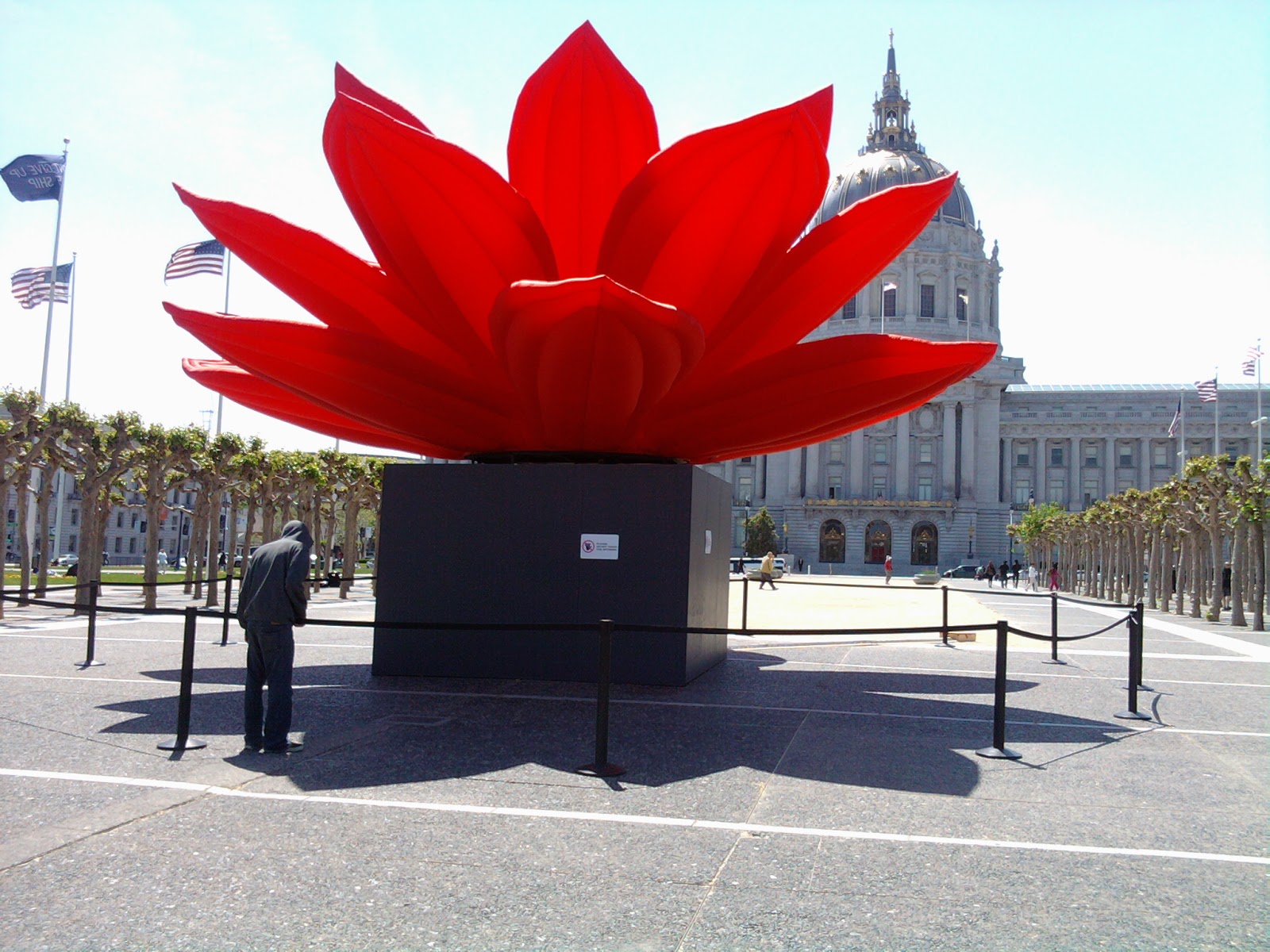
Breathing Flower at SF Civic Center

Choi Jeong Hwa's Breathing Flower at the Civic Center
Plaza across from the Asian Art Museum. Photo by Kim Munson.
Was headed to the SF Public Library yesterday, and was blown away by Choi Jeong Hwa's 24 foot sculpture Breathing Flower, which is on display in the Civic Center Plaza across from the Asian Art Museum as part of the Phantoms of Asia exhibition. Read more about it at SFGate at