I'm proud to post that the exhibition catalog for our San Francisco photography show is now available on Blurb as an e-book or print on demand. Tom Griscom and Wendy Crittenden's photos look beautiful.
The show is opening Thursday 4/2 5-7pm at the Special Collections Gallery on the 4th floor of the library at San Francisco State University. Tom & Wendy are scheduled to talk about their work at 6pm.
Check out the demo below:
Showing posts with label LARC. Show all posts
Showing posts with label LARC. Show all posts
Sunday, November 16, 2014


Wednesday, October 15, 2014
Silent Expressionists: Wordless! and Wordless Novels
On October 10th, Marc and I saw Wordless!, a presentation on wordless novels by Art Spiegelman in collaboration with jazz composer Phillip Johnston and a 6 man jazz band (including Johnson on soprano sax). Spiegelman began the evening speaking about the concepts that make comics work, and the odd marriage of word & image, and then continued with animated slideshows of works by artists telling stories without words accompanied by Johnston and the band. In many ways, it felt very much like a series of short silent films with musical accompaniment and narrative interludes. The featured artists were A.B. Frost; Frans Masereel; H.M. Bateman; Lynd Ward; Otto Nückel; Milt Gross; Si Lewen and Wilhelm Busch, plus Spiegelman’s own work. We saw this show at Zellerbach Hall at UC Berkeley; at this time the show is continuing to tour (see dates here).
I was happy to hear about this show, as it coincided with my own curiosity about Giacomo Patri’s White Collar (1940), a depression era story told in woodcuts, which the Labor Archives and Research Center currently has on display at the SFSU library. While the influence of 19th Century and German Expressionist woodcuts was obvious, I struggled a bit with putting this work in larger context. Spiegelman’s presentation and David A. Beronä’s excellent survey book Wordless Books: the Original Graphic Novels have really helped in this regard, giving me both an overview of the genre and the characteristics of the work. While there is some humorous work, generally it seems that topics like morality, war, and social injustice motivated prolific artists like Franz Masereel and Lynd Ward to spend endless hours physically carving images into blocks of wood.
Spiegelman began his presentation by filling the audience in on his background between puffs on an e-cigarette (“I’m a nervous New Yorker” he said, peering over the podium). Many of the images used in this segment would be familiar to anyone who has read Breakdowns or has seen him speak before. He spoke about the literary importance of comics (covered in detail on Paris Review), and then got into the meat of the evening’s topic. He explained his need to develop a visual storytelling style that would be appropriate for telling his family story, and that he found himself attracted to the bold lines of the woodcut novels. When he was 22, he met Lynd Ward at a gallery opening, and upon asking Ward what comics he read, was surprised to learn that Ward’s father, a Methodist minister, had forbidden the funnies, and that the biblical engravings of Gustave Doré were Ward’s main inspiration. Spiegelman still found inspiration in Ward’s work, incorporating elements of the Expressionist woodcut style into Prisoner from Hell Planet, the harrowing story of his mother’s suicide.
After this story, his presentation of the artists and their works began in earnest. “Don’t worry if you get a little lost while you’re watching,” he told us. “I’m hoping you will careen between my words and these picture stories until you’re left as breathlessly unbalanced as I am.” As the slideshow of artist's work unfolded, I found myself slipping into an unconscious understanding of the imagery as I tried to follow the thread of unspoken narrative, helped along by Johnston’s musical interpretations. It’s one thing to hold these books in your hands and puzzle over their content alone, it’s another to see them as a performance and puzzle over their sometimes abstract content with the rest of the audience. The band had its best moment during the closing piece, a new work by Spiegelman called Shaping Thought (there's a bit of it in the trailer above), that emphasized the best qualities of both the musicians and the cartoonist, a true collaborative effort. The historical segments on Masereel and Ward were the core of show; the innovators who established the elements of the genre that everyone else would follow in one way or another, and I found myself truly intrigued by their work.


Although not included in the show, this plate from Masereel's 1952 book Notre Temps is typical of his work on the theme of war and poverty. The confining lines of the barbed wire and the strong lines of stakes contrast strongly with the horizontal lines of the background, giving the reader insight into the despair of the man in the center.
Lynd Ward (1905-1985) was directly inspired by Masereel’s wordless novel The Sun (1919), which he discovered while spending a year abroad at the National Academy of Graphic Arts in Leipzip, Germany in 1926. He grew up in New York, and was a graduate of Columbia University. Dr. Harry Ward, the father who disapproved of comics, was a writer, social activist, and the first board Chairman of the American Civil Liberties Union. Lynd inherited his father’s passion for nature and activism, and brought those themes into his novels. Aside from his wordless novels, he was a prolific and successful book illustrator, winning both the Newberry and Caldecott Medals.
In 2010, Spiegelman edited a collection of six of Ward’s novels for the Library of America, so he was able to spend a chunk of time exploring Ward’s work. In the Wordless! Show, he focused on three of Ward’s novels:
God’s Man (1929), a classic tale of an artist that makes a deal with the devil for fame and fortune, only to lose everything after becoming disillusioned with fame in the city and finding true love in a rural, natural setting.
Wild Pilgrimage (1932) is a depression era story that follows the challenges of a man that leaves a factory town, is educated by a hermit in the woods, and then returns to challenge and be killed by the factory guards. The real innovation in this book is Ward’s effort to show the man’s inner life, by printing pages of fantasy/thought sequences in orange, returning to regular black ink in the real world.
Vertigo (1937), a 230 page book that Ward considered his masterpiece, is the story of a girl, a boy, and an elderly gentleman, and the way their lives cross in the course of their lives. As he follows the lives of the characters, Ward shows the injustices and indignities of the Depression.

Seeing these images adds another layer of meaning and complexity to Prisoner from Hell Planet. Spiegelman uses the lessons of the woodcut artists by utilizing the bold lines of the woodcut style. Lines and textures run in all directions, leaving the reader’s eye with nowhere to rest, a compositional choice that lends a sense of visual anxiety to this raw and heartbreaking story of guilt and tragedy. In the final two panels, the geometric grid of bars and jail cells enclose him. The regular lines seems strangely peaceful after the chaos of the previous panels, yet we feel that he will be trapped in there forever as he says "Congratulations! You've committed the perfect crime... you put me in here.. shorted all my circuits.. cut my nerve endings... and crossed my wires... you murdered me Mommy, and you left me here to take the rap."
I can also see why Spiegelman decided not to include White Collar in the show. Patri’s work,while it does have unique qualities of its own, did borrow a lot of ideas from Wild Pilgrimage: the orange printed pages of inner dialog, the occasional use of words on signage to make the meaning of a page clear, and the general theme of the injustices done to working people during the Depression era.
Since White Collar piqued my interest in wordless novels, I have recently found one or two others of interest; Combustion, a 1998 novel by Chris Lanier in which a solider at a protest watches a man light himself on fire, after which the solider gradually comes to sympathize with the enemy (very much in the Masereel tradition), and the Raven and the Red Ball, a light-hearted children's book featuring a game between a dog and a mischievous raven, which perfectly utilizes the woodcut style to show flight and movement.
I was happy to hear about this show, as it coincided with my own curiosity about Giacomo Patri’s White Collar (1940), a depression era story told in woodcuts, which the Labor Archives and Research Center currently has on display at the SFSU library. While the influence of 19th Century and German Expressionist woodcuts was obvious, I struggled a bit with putting this work in larger context. Spiegelman’s presentation and David A. Beronä’s excellent survey book Wordless Books: the Original Graphic Novels have really helped in this regard, giving me both an overview of the genre and the characteristics of the work. While there is some humorous work, generally it seems that topics like morality, war, and social injustice motivated prolific artists like Franz Masereel and Lynd Ward to spend endless hours physically carving images into blocks of wood.
 |
| Fantasy sequences from LARC's display of White Collar by Giacomo Patri (1940) |
 |
| Gustave Dore, St. John's Vision. 1866. |
 |
| Art Spiegelman. Prisoner from Hell Planet, Pages 3 & 4 |
After this story, his presentation of the artists and their works began in earnest. “Don’t worry if you get a little lost while you’re watching,” he told us. “I’m hoping you will careen between my words and these picture stories until you’re left as breathlessly unbalanced as I am.” As the slideshow of artist's work unfolded, I found myself slipping into an unconscious understanding of the imagery as I tried to follow the thread of unspoken narrative, helped along by Johnston’s musical interpretations. It’s one thing to hold these books in your hands and puzzle over their content alone, it’s another to see them as a performance and puzzle over their sometimes abstract content with the rest of the audience. The band had its best moment during the closing piece, a new work by Spiegelman called Shaping Thought (there's a bit of it in the trailer above), that emphasized the best qualities of both the musicians and the cartoonist, a true collaborative effort. The historical segments on Masereel and Ward were the core of show; the innovators who established the elements of the genre that everyone else would follow in one way or another, and I found myself truly intrigued by their work.
 |
| Franz Masereel. Two plates from Passionate Journey (1919) |
Frans Masereel (1889-1972) had a life-long devotion to the woodcut medium. Between the publication of his first portfolio in 1917 and his death in 1972, Masereel created numerous book illustrations and over 50 wordless books. He grew up in a middle class family in Ghent, Belgium, and he moved to Geneva at the beginning of WWI, were he worked for the International Red Cross and the International Pacifist Movement. He became a political cartoonist, and throughout his life he depicted the brutality of war, the dehumanization resulting from the industrial revolution, and the complexities of everyday city life in his novels and illustrations. The line work and composition of Masereel’s work remind me very much of Goya’s engravings (particularly the Disasters of War series) and the work of Masereel’s contemporary Käthe Kollwitz, who frequently created woodcuts commenting on similar themes of war and labor strife. Spiegelman choose to show sequences from Passionate Journey (1919) and The City (1925), both works that show the joys and tragedies of relationships and city life.
 |
| Franz Masereel. Two plates from The City (1925) |
 |
| Franz Masereel. Plate from Notre Temps (1952) |
 |
| Käthe Kollwitz. Memorial Sheet to Karl Liebknecht. 1919. |
 |
| Käthe Kollwitz. The Volunteers, 1923. |
In 2010, Spiegelman edited a collection of six of Ward’s novels for the Library of America, so he was able to spend a chunk of time exploring Ward’s work. In the Wordless! Show, he focused on three of Ward’s novels:
God’s Man (1929), a classic tale of an artist that makes a deal with the devil for fame and fortune, only to lose everything after becoming disillusioned with fame in the city and finding true love in a rural, natural setting.
 |
| Lynd Ward. Plate from God's Man, 1929. |
 |
| Lynd Ward. Two plates from Wild Pilgrimage, 1932. |
 |
| Lynd Ward. Two plates from Vertigo, 1937. |
I can also see why Spiegelman decided not to include White Collar in the show. Patri’s work,while it does have unique qualities of its own, did borrow a lot of ideas from Wild Pilgrimage: the orange printed pages of inner dialog, the occasional use of words on signage to make the meaning of a page clear, and the general theme of the injustices done to working people during the Depression era.
Since White Collar piqued my interest in wordless novels, I have recently found one or two others of interest; Combustion, a 1998 novel by Chris Lanier in which a solider at a protest watches a man light himself on fire, after which the solider gradually comes to sympathize with the enemy (very much in the Masereel tradition), and the Raven and the Red Ball, a light-hearted children's book featuring a game between a dog and a mischievous raven, which perfectly utilizes the woodcut style to show flight and movement.
 |
| Raven and the Red Ball. Sarah Drummond. 2013 |
 |
| Combustion by Chris Lanier, 1998. |
Monday, July 21, 2014
Giacomo Patri - White Collar: A Novel in Linocuts
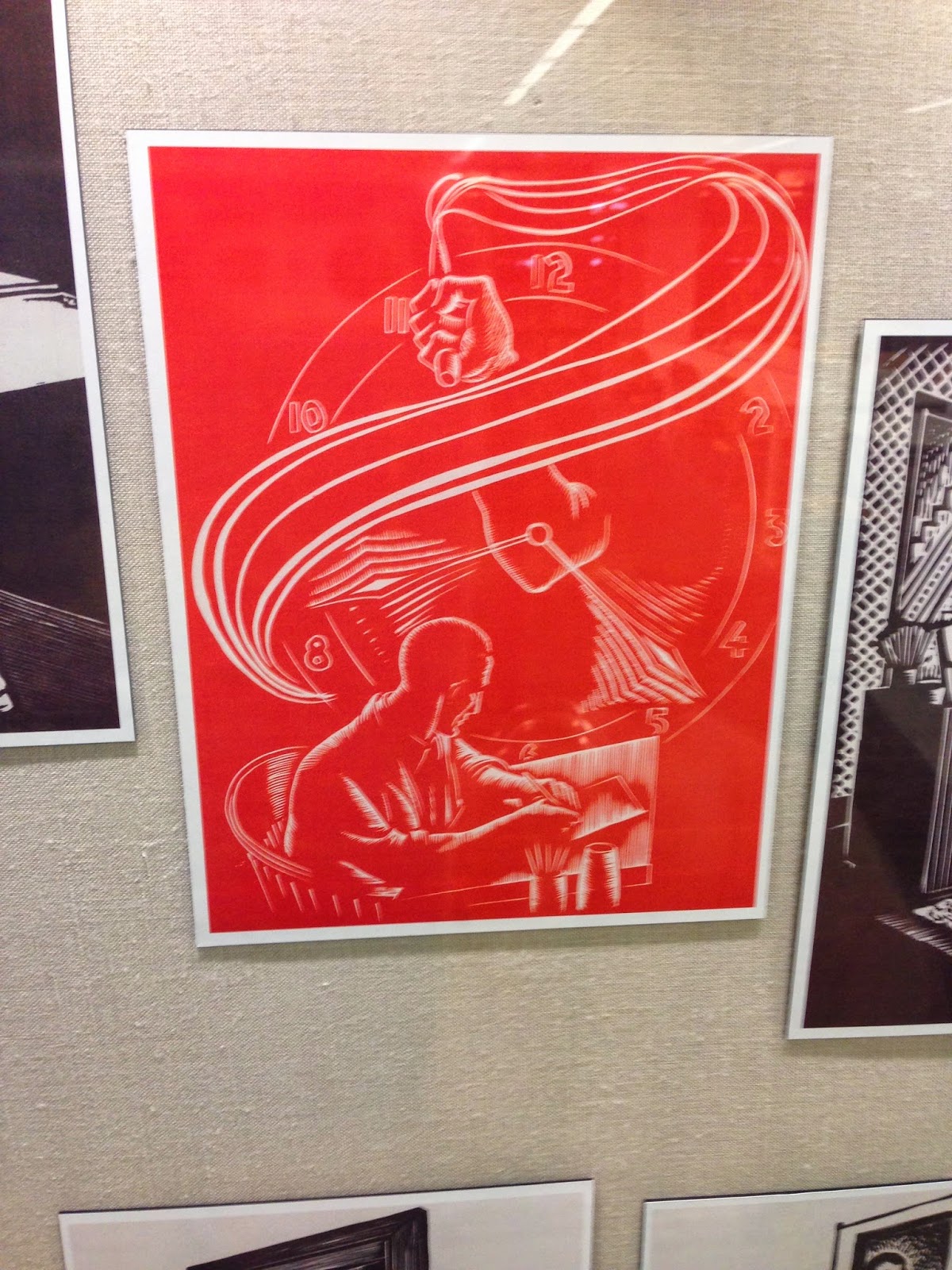
The Labor Archive and Research Center at the SFSU J. Paul Leonard Library has a display of the long out of print 1940 book White Collar: A Novel in Linocuts by Giacomo Patri (1898–1978), which is illustrated with linocut prints in two colors. The first edition of this wordless volume was hand printed by Patri and bound with his wife's assistance, two other editions were commercially printed.
Patri was born in Italy. Frustrated with a series of unfulfilling jobs, he went to night school to learn to be an artist. He worked in different capacities for 3 bay area newspapers, The San Francisco Examiner, The Call-Bulletin, and The San Francisco Chronicle. In the WWII era, he began teaching at the California Labor School and became the head of the Art Dept, while also doing freelance work for unions. After the Labor School was closed during the Red Scare in 1957, he had his own art school and kept freelancing until he retired in 1966.
The story follows the life of a mid-level advertising executive who suffers joblessness and tragedy after the 1929 stock market crash. Patri saw that white collar workers considered themselves professionals who saw no benefit from the union protections earned by blue collar workers, so they frequently shunned organizing campaigns and union activity. In the book Patri contrasts the isolation of the white collar worker trying to solve his own problems in isolation with the activity of the collective, eventually resulting in the white collar worker joining in united action. Here is a blog post with very clear scans.
The photos below are cell snaps of the exhibit in 4 cases on the 4th floor of the library.




Patri was born in Italy. Frustrated with a series of unfulfilling jobs, he went to night school to learn to be an artist. He worked in different capacities for 3 bay area newspapers, The San Francisco Examiner, The Call-Bulletin, and The San Francisco Chronicle. In the WWII era, he began teaching at the California Labor School and became the head of the Art Dept, while also doing freelance work for unions. After the Labor School was closed during the Red Scare in 1957, he had his own art school and kept freelancing until he retired in 1966.
The story follows the life of a mid-level advertising executive who suffers joblessness and tragedy after the 1929 stock market crash. Patri saw that white collar workers considered themselves professionals who saw no benefit from the union protections earned by blue collar workers, so they frequently shunned organizing campaigns and union activity. In the book Patri contrasts the isolation of the white collar worker trying to solve his own problems in isolation with the activity of the collective, eventually resulting in the white collar worker joining in united action. Here is a blog post with very clear scans.
The photos below are cell snaps of the exhibit in 4 cases on the 4th floor of the library.
Sunday, July 20, 2014
Dual Views: Labor Landmarks show to open April 2015
 |
| Landmarks photography by Wendy Crittenden (color, top) and Tom Griscom (B&W, below)
Dual Views: Labor Landmarks of San Francisco will be exhibited at SFSU from April 2, 2015 through mid-July (details below). Taken in 2008 in the recovery from the 1999-2000 tech boom/bust cycle, Griscom’s black and white panoramas and Crittenden’s askew color c-prints celebrate the resilience of the ever-changing Waterfront, South of Market,Glen Park, Dogpatch, and North Beach areas while searching for echoes of their turbulent history.
The two photographers separately visited sites both iconic and “under the radar,” in an effort to capture the rebuilding period between economic cycles and to draw attention to the underlying history of militant labor struggles that helped shape the physical and political landscape of the city. While sifting through archival materials for this show, I continue to be amazed both by the dramatic changes in the city from one period to the next, and at the sacrifices people made to fight off companies that were exploiting their work. The Dual Views show will be exhibited in the Special Collections Gallery on the 4th floor of the newly remodeled J. Paul Leonard Library at San Francisco State University, opening April 2nd and going through mid-July. An opening event/reception on April 2 and a closing event to coincide with Laborfest are being planned. As alumni, Tom, Wendy and I are all looking forward to finally showing this body of work at SFSU, and have been happy to continue our relationship with the Labor Archives and LARC director Catherine Powell. The show will feature 11 photos each from Crittenden and Griscom, plus contextual material pulled from LARC's deep collection of historical artifacts. I have been developing a catalog, and hope to announce how it can be accessed soon. You can preview some of the pieces that will be featured in the show in the slideshow below. If you are a publisher and are interested in seeing a proposal, please contact me at kim_munson AT yahoo.com and I will be happy to send you one. |
Saturday, June 20, 2009
Upcoming Speaking Gigs
Forgive me for a moment of self promotion, but there are some events coming up worth checking out:
July 19 (Sunday), 1:00. Labor Archives and Research Center at SFSU. I will be talking about the Evolution of the Arm & Hammer logo as part of Laborfest. Tom Griscom's labor landmarks photography will be included in the Laborfest Art Show opening July 9 at SOMArts. This year Laborfest includes many panels of interest to artists trying to make a living, so be sure to check out the event schedule on their site.
 July 26 (Sunday), 1:00. San Diego Comic Con. Comic Art and Museums panel. I will be speaking about my new research about The Comic Art Show (1983) and a recent interview I did with John Carlin, Michael Dooley will be talking about High & Low (1990) and Masters of American Comics (2005). Mega-publisher/collector Denis Kitchen will be talking about new exhibitions and trends. We are expecting a lively discussion, so check it out. Husband Marc is also speaking on Thursday morning about CBLDF and the Superman copyright case.
I've just confirmed that I will be speaking about the history of the union label at the AFL-CIO Union Label and Service Trades Department's 100th anniversary convention which will be held in Pittsburgh on September 12th. More later.
Tuesday, April 28, 2009
Signs of Unity: Stories and Symbols of the American Union Label Movement
Recently I was cleaning up some of the old content on this blog, and I was dumbfounded when I realized that I have never posted anything specific about the Union Label project that I have been researching off and on over the last 4 years. This will be a book that analyzes the graphic symbolism used in US labor union emblems, such as the AFL-CIO’s “hand-in-hand” logo, from the beginning of the union label movement in the Victorian era through the present, to demonstrate how these emblems, many of which have changed dramatically during this period, reflect the attitudes of society and of the worker’s self image, and the contribution the unions and their members have made to the fabric of American society and culture.
After the Civil War, American labor unions began using individual logos, both as a means of group identification, and as printed seals or labels affixed to union made products, to assure the consumer of the quality of the products manufactured in union shops. The label movement was also a non-violent means of garnering public support for the labor movement, by encouraging boycotts of products made by companies that did not support labor’s goals. The role symbols play in developing a sense of identity, and their ability to convey, in non-verbal context, important messages about cultural values, is also explored in this work.
 Over the decades since the civil war, the symbols and messages contained in these logos have changed due to union mergers, economic transformations, changes in the political climate, and cultural/societal trends in general. Aside from this historical survey, I also plan a reference section that will show all the different versions of these logos (I’m estimating there will be about 200) and whatever information I have been able to collect about their specific use and origin.
How did I get into this, you ask? Well, I grew up in a blue collar family in a small town in Northern Michigan (Manistee, MI). Both my parents were in unions (Atomic & Chemical Workers & the Ladies' Garment Workers) and later I had my own union experiences (IATSE). I hadn’t thought much about it for a long time, and then in 2006 I did the Battle Emblems show at Intersection for the Arts. This show explored 13 well-known graphic symbols used by labor and social movements (like the globe logo of the IWW or the Peace Sign). While I was researching the labor symbols at the Labor Archives at SFSU, I realized that this is a neglected area. Also, people have no real awareness of this history anymore. A friend who teaches Political Science at CCSF assigned an extra credit report about the show to her classes, and we were amazed by the student’s attitudes. They seemed to have little interest in the idea that organizing for a common goal could be an effective way to instigate change, and seemed to think that rights like the weekend and the 8 hour day have just always existed. People suffered and died for these rights, and they deserve to be remembered.
Have a union label story? Leave a comment.
Saturday, April 25, 2009
Best of SlideShare
 I just found a notice from SlideShare that 2 of my posted presentations were designated "Best of SlideShare" around the beginning of April. Most viewed were the sample slides of my work on art exhibitions and the SF Labor Landmarks photography proposal (photos by Wendy Crittenden and Tom Griscom on the left). Thanks, whoever you are.
Thursday, April 23, 2009
Tribute to Archie Green
 A Celebration of the life and work of Labor Folklorist Archie Green will be held at San Francisco State University's McKenna Theatre on June 21st for 1-4 pm.
Archie, who passed on last month at the age of 91 (see my blog entry for 3/29/09), took special joy in collecting the songs of the labor movement, so it's totally appropriate that the event will include musical performances by Hazel Dickens, Mike Seeger and Elaine Purkey. Please RSVP to Archie's son, Derek Green at derekgreen (at) att.net.
Please check the SFSU site for directions, parking information, etc.
Wednesday, April 15, 2009
Kim Speaking at Laborfest
 Evolution of an Emblem: The Arm & Hammer at LARC, Sunday, 7/19/09 at 1:00.
How did the arm & hammer end up on all those baking soda boxes? Art Historian Kim Munson shares her investigation of the origins of the arm & hammer from Greco-Roman myth and its role as an early union label to its current usage as the Socialist Labor Party emblem and as the baking soda trademark. Hosted by the Labor Archives and Research Center, SFSU, 480 Winston Drive, San Francisco, CA 94132. Contact: larc@sfsu.edu Phone: 415-564-4010.
BTW, A while ago I designed an on-line exhibit of union labels for LARC. Some of the graphics in the "promoting the label" section, especially the posters, are really interesting.
Sunday, March 29, 2009
Archie Green (1917-2009)
I was sad to see in today’s news that Archie Green, labor folklorist and force of nature, passed away this week at 91. There’s a fabulous and detailed article about him in today’s NYT, so I won’t go in depth about his biography here. To summarize for my friends that didn’t know him, as a young man Archie worked in the Civilian Conservation Corps through the New Deal era, then was an organizer for the SF shipyard unions. Later he moved into academia, and was responsible not only for the way we think of “laborlore” (in fact, he coined the term) but he was also the motivating force behind the American Folklife Preservation Act, signed into law by President Gerald Ford in 1976. He left behind a treasure trove of publishing and scholarship, including his last work, The Big Red Songbook (a compilation of songbooks published by the Wobblies), finished a couple years ago, and The San Francisco Labor Landmarks Guidebook with the Labor Archives and Research Center, SFSU. In 2007, Archie was awarded the “Living Legends Award” by the Library of Congress.
 Archie, pictured here at a New Deal Conference at CCSF last year, was a down to earth and inspiring speaker, and an advocate for the intelligent analysis of everyday life. I will always be grateful for his encouragement when I started researching the labor labels project a few years ago, and the topic I’m currently working on, the evolution of the arm & hammer logo, was inspired by a question posed by him. Mostly though, I feel indebted to Archie for persuading “the academy” to accept the idea that things that happen to everyday people are worth studying, and this idea has informed and made possible every project I’ve worked on, from labor to comics.
Archie’s family has requested memorial donations to educational institutions or to the Fund for Labor Culture and History, San Francisco.
Saturday, October 18, 2008
24 Hour Comics & The New Deal - 2 Great Events in SF!
 A quick post to mention 2 great events I experienced in SF over the last couple days: First, the 24 Hour Comics Jam hosted by Comic Outpost on Ocean Avenue. As I'm writing it's still going on, and will continue overnight. The artists, members of Cartoonist Conspiracy, are attempting to draw a 24 page comic in 24 hours (11 am 10/18 to 11 am 10/19). When Marc and I were there earlier, the place was packed with artists drawing, and onlookers eating pizza and checking out the sale. If you want comics tonight at 3am, this is the place. More info on the Comic Outpost site. I'm sure Gary B. will post photos of the event on his site shortly afterward, unfortunately my cell snaps were too blurry to share (looks like people drawing and eating pizza underwater).
The second event was the Reviving the New Deal conference at CCSF (10/16 & 17). It was amazingly well attended for a conference on an absolutely gorgeous Friday afternoon! The two panels I attended were about Teaching the New Deal and the Art of the New Deal. Given the current financial problems in this country, it was astounding to hear people talking all afternoon about how the government actually stepped in and helped people back then. The government invested money in things like building schools, libraries and town halls and they put people to work, even artists. CCSF itself was a WPA project, flaunting a wealth of Deco architecture and Diego Rivera murals.
In the photo to the left, Archie Green told the audience stories of the theatre, songs and other Laborlore of the WPA era. He worked for the CCC and reminisced about men hauling boulders around to build the Tamalpais Theatre. Other speakers included Lincoln Cushing, who talked about silkscreen prints (he has a labor poster book coming out soon); Catherine Powell from the Labor Archives at SFSU; Gray Brechin who spearheaded the California Living New Deal project; and Martin Meeker from the California Council on the Humanities, who showed us an impressive new web site called We Are California, that has collected the stories of immigrants (both foreign and domestic). It's probably wishful thinking, but I hope that someday soon, our government decides that people are worth bailing out too.
Sunday, October 5, 2008
Photos of YBCA Walking Tour 10/4
After days of hearing forecasts of pouring rain on Saturday afternoon, it turned out to be a beautiful day in San Francisco. Kim, Jessica, Valerie and Catherine led a group of about 15 participants around the stencil sites, starting at YBCA and continuing to SFMOMA, the Asian Art Museum, Bill Graham Civic Auditorium, Davies Symphony Hall, the War Memorial Opera House, the Herbst Theatre and the Lusty Lady.
What isn't obvious in these photos is that this was also the weekend of the Love Fest and parade, which climaxed at civic center about the same time we were there. It was challenging to be heard, but there was lots to look at (tons of photos on Flickr). On the whole, we think everyone enjoyed it. Thanks to YBCA for inviting us!
What isn't obvious in these photos is that this was also the weekend of the Love Fest and parade, which climaxed at civic center about the same time we were there. It was challenging to be heard, but there was lots to look at (tons of photos on Flickr). On the whole, we think everyone enjoyed it. Thanks to YBCA for inviting us!
Wednesday, October 1, 2008
Walking Tour of Stencil Sites - Oct 4
Syndicate, a collaborative project celebrating unionized workers in San Francisco performance and art spaces, has been included as part of the GroundScores component of Bay Area Now 5, showing at Yerba Buena Center for the Arts from 7/19/08-10/13/08. The walking tour features street stencils of historic photographs in front of theatres and museums starting downtown at YBCA and SFMOMA and then continuing to civic center (Asian Art Museum, Bill Graham Civic, Davies Symphony Hall, the Opera House and the Herbst Theatre). Some of the stencils are also shown in the gallery exhibition, which also includes a video by Jessica Tully (video/stencils/performance artist) along with text by Kim and photography by Tom Griscom & Wendy Crittenden. The guided tour will be led by Kim, Jessica, Catherine Powell (from the SFSU Labor Archives, another collaborator), Valerie Imus (GroundScores curator) and other guests from noon to 2:30 on Sat, 10/4.
Because of the Love Fest parade on Market Street and Civic Center, and the possibility of driving rain on Saturday, we may be forced to postpone this tour. If you plan to come, please e-mail Kim at kim_munson (at) yahoo.com or call YBCA at 415.978.2787 to check for current information. Click here to see more images and information on YBCA's web site.
Kim, Tom & Wendy will be presenting at SFSU on this topic on the evening of 10/20.
Friday, August 29, 2008
Syndicate continues at YBCA through 10/13
Syndicate, a collaborative project celebrating unionized workers in San Francisco performance and art spaces has been included as part of the GroundScores component of Bay Area Now 5, showing at Yerba Buena Center for the Arts from 7/19/08-10/13/08. The walking tour features street stencils of historic photographs in front of theatres and museums both downtown and at civic center. Some of the stencils are also shown in the gallery exhibition, which also includes a video by Jessica Tully (video/stencils/performance artist) along with text by Kim and photography by Tom Griscom & Wendy Crittenden.
There will be a guided tour with Kim, Jessica, Catherine Powell (from the SFSU Labor Archives, another collaborator) and other guests from noon to 2:30 on Sat, 10/4. Get tickets for the tour on YBCA's web site. Kim, Tom & Wendy will be presenting at SFSU on this topic on the evening of 10/13.
There will be a guided tour with Kim, Jessica, Catherine Powell (from the SFSU Labor Archives, another collaborator) and other guests from noon to 2:30 on Sat, 10/4. Get tickets for the tour on YBCA's web site. Kim, Tom & Wendy will be presenting at SFSU on this topic on the evening of 10/13.
Friday, August 22, 2008
New Labor Landmarks site
 Tom Griscom has built a new section onto his web site featuring the photography he's been doing for the SF Labor Landmarks project (in collaboration with photographer Wendy Crittenden, myself and Catherine Powell of the SFSU Labor Archives). There's also another photo from this project in my August 3rd posting. This project is still looking for a home, so please contact me if you have ideas.
Thursday, August 7, 2008
YBCA/BAN5 Syndicate project
Syndicate, a project celebrating unionized workers in San Francisco performance and art spaces has been included as part of the GroundScores component of Bay Area Now 5, showing at Yerba Buena Center for the Arts from 7/19/08-10/13/08. The walking tour features street stencils of historic photographs in front of theatres and museums both downtown and at civic center. Some of the stencils are also shown in the gallery exhibition, which also includes a video by Jessica Tully (video/stencils/performance artist) along with photography by Tom Griscom & Wendy Crittenden. Kim researched & coordinated this project, including the city permits process and writing & recording parts of the podcast.
There will be a guided tour with Kim, Jessica, Catherine Powell (from the SFSU Labor Archives, another collaborator) and other guests from noon to 2:30 on Sat, 10/4. Get tickets for the tour on YBCA's web site.
There will be a guided tour with Kim, Jessica, Catherine Powell (from the SFSU Labor Archives, another collaborator) and other guests from noon to 2:30 on Sat, 10/4. Get tickets for the tour on YBCA's web site.
Sunday, August 3, 2008
Dual Views: Labor Landmarks of San Francisco

Drawing on the research, archival photos, and maps collected in the SFSU Labor Archive's upcoming Labor Landmarks book,and their own visits to these sites of historical importance to the San Francisco labor movement, Crittenden (color) and Griscom (b&w) have created intriguing contemporary views of those sites in their contrasting yet complimentary styles. Photography is completed, we are assembling a package to find a home in the bay area for this show. We plan a gallery exhibition coupling this series of large scale photographic works with related historical information and period photos. There is a pdf of our proposal on my archive page.
Subscribe to:
Posts (Atom)