I'm proud to post that the exhibition catalog for our San Francisco photography show is now available on Blurb as an e-book or print on demand. Tom Griscom and Wendy Crittenden's photos look beautiful.
The show is opening Thursday 4/2 5-7pm at the Special Collections Gallery on the 4th floor of the library at San Francisco State University. Tom & Wendy are scheduled to talk about their work at 6pm.
Check out the demo below:
Showing posts with label labor. Show all posts
Showing posts with label labor. Show all posts
Sunday, November 16, 2014


Monday, July 21, 2014
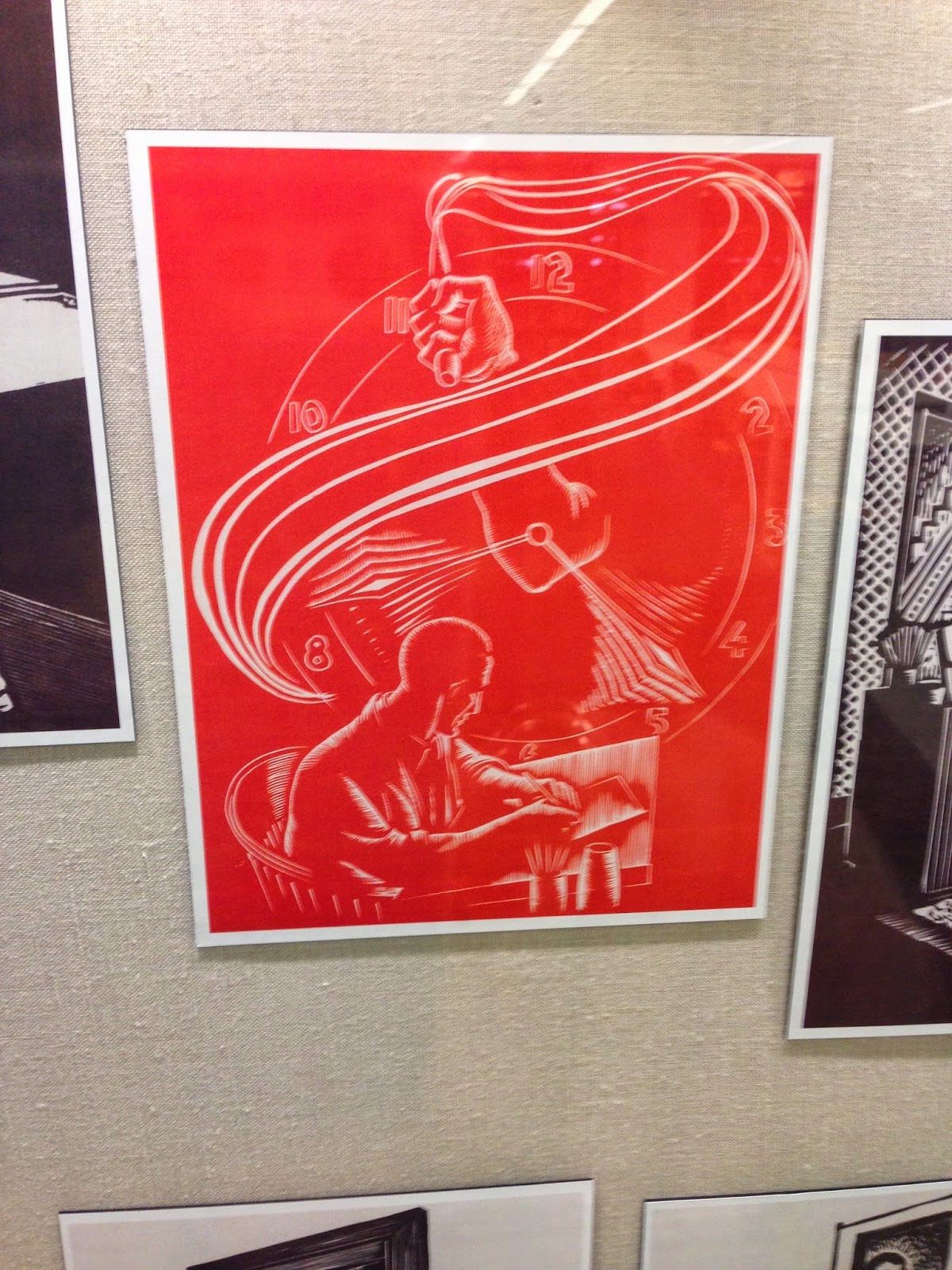
Giacomo Patri - White Collar: A Novel in Linocuts
The Labor Archive and Research Center at the SFSU J. Paul Leonard Library has a display of the long out of print 1940 book White Collar: A Novel in Linocuts by Giacomo Patri (1898–1978), which is illustrated with linocut prints in two colors. The first edition of this wordless volume was hand printed by Patri and bound with his wife's assistance, two other editions were commercially printed.
Patri was born in Italy. Frustrated with a series of unfulfilling jobs, he went to night school to learn to be an artist. He worked in different capacities for 3 bay area newspapers, The San Francisco Examiner, The Call-Bulletin, and The San Francisco Chronicle. In the WWII era, he began teaching at the California Labor School and became the head of the Art Dept, while also doing freelance work for unions. After the Labor School was closed during the Red Scare in 1957, he had his own art school and kept freelancing until he retired in 1966.
The story follows the life of a mid-level advertising executive who suffers joblessness and tragedy after the 1929 stock market crash. Patri saw that white collar workers considered themselves professionals who saw no benefit from the union protections earned by blue collar workers, so they frequently shunned organizing campaigns and union activity. In the book Patri contrasts the isolation of the white collar worker trying to solve his own problems in isolation with the activity of the collective, eventually resulting in the white collar worker joining in united action. Here is a blog post with very clear scans.
The photos below are cell snaps of the exhibit in 4 cases on the 4th floor of the library.




Patri was born in Italy. Frustrated with a series of unfulfilling jobs, he went to night school to learn to be an artist. He worked in different capacities for 3 bay area newspapers, The San Francisco Examiner, The Call-Bulletin, and The San Francisco Chronicle. In the WWII era, he began teaching at the California Labor School and became the head of the Art Dept, while also doing freelance work for unions. After the Labor School was closed during the Red Scare in 1957, he had his own art school and kept freelancing until he retired in 1966.
The story follows the life of a mid-level advertising executive who suffers joblessness and tragedy after the 1929 stock market crash. Patri saw that white collar workers considered themselves professionals who saw no benefit from the union protections earned by blue collar workers, so they frequently shunned organizing campaigns and union activity. In the book Patri contrasts the isolation of the white collar worker trying to solve his own problems in isolation with the activity of the collective, eventually resulting in the white collar worker joining in united action. Here is a blog post with very clear scans.
The photos below are cell snaps of the exhibit in 4 cases on the 4th floor of the library.
Sunday, July 20, 2014
Dual Views: Labor Landmarks show to open April 2015
 |
| Landmarks photography by Wendy Crittenden (color, top) and Tom Griscom (B&W, below)
Dual Views: Labor Landmarks of San Francisco will be exhibited at SFSU from April 2, 2015 through mid-July (details below). Taken in 2008 in the recovery from the 1999-2000 tech boom/bust cycle, Griscom’s black and white panoramas and Crittenden’s askew color c-prints celebrate the resilience of the ever-changing Waterfront, South of Market,Glen Park, Dogpatch, and North Beach areas while searching for echoes of their turbulent history.
The two photographers separately visited sites both iconic and “under the radar,” in an effort to capture the rebuilding period between economic cycles and to draw attention to the underlying history of militant labor struggles that helped shape the physical and political landscape of the city. While sifting through archival materials for this show, I continue to be amazed both by the dramatic changes in the city from one period to the next, and at the sacrifices people made to fight off companies that were exploiting their work. The Dual Views show will be exhibited in the Special Collections Gallery on the 4th floor of the newly remodeled J. Paul Leonard Library at San Francisco State University, opening April 2nd and going through mid-July. An opening event/reception on April 2 and a closing event to coincide with Laborfest are being planned. As alumni, Tom, Wendy and I are all looking forward to finally showing this body of work at SFSU, and have been happy to continue our relationship with the Labor Archives and LARC director Catherine Powell. The show will feature 11 photos each from Crittenden and Griscom, plus contextual material pulled from LARC's deep collection of historical artifacts. I have been developing a catalog, and hope to announce how it can be accessed soon. You can preview some of the pieces that will be featured in the show in the slideshow below. If you are a publisher and are interested in seeing a proposal, please contact me at kim_munson AT yahoo.com and I will be happy to send you one. |
Sunday, August 1, 2010
Griscom in Fraction Magazine
 |
| Beale Street, Tom Griscom |
Saturday, October 17, 2009
Griscom Gets a Rave!
 SF photographer Tom Griscom's labor landmarks photos recently got a rave review on Jen Bekmen's Hey Hot Shot blog. Tom started this body of work while we were both finishing up our programs at San Francisco State, which sort of culminated in the Syndicate collaboration with the Labor Archives at SFSU for Bay Area Now 5. Some of this work has also been included in the SFSU 2009 MFA show and as part of Laborfest:Art & Labor Today. Griscom has continued to build on the framework of this narrative and done some beautiful work. To the left is Griscom's photograph of Beale Street in San Francisco.
Griscom has also been assisting photographer David Maisel on his latest series, the X-Ray Project, which is based on x-rays of artwork taken during Maisel's residency at the Getty Research Institute in 2007.
Friday, October 2, 2009
Update on Pittsburg Trip
 Here I am in Pittsburgh, after speaking at the Union Label and Service Trades Dept. -AFL-CIO's 68th convention. I spoke on the label department's history (and label history in general) to commemorate their 100th anniversary. Thanks to ULSTD president Richard Kline for inviting me (that's him in grey) and to Greg Kenefick of Kenefick Communications (in tan) for all his help.
My labels project is currently featured on the ulstd's web site and was also featured in the newsletter of the International Labor Communications Association (thanks to Steve Stallone and Fred Glass). You can see the presentation on my labor history slideshow page.
 Maybe it's my Northern Michigan upbringing, but I am also a huge football fan. I was so focused on the details of my trip to Pittsburgh and New York, that I completely spaced out on the fact that the NFL season kickoff game was happening in Pittsburgh the same day I was flying in (Sept 10). I flew Jet Blue with a short stop over at Kennedy in NY. On the NY-PIT leg of the flight, almost everyone on the plane was wearing a black & gold Steelers jersey. On arrival, the city was crawling with fans. There was a free concert with the Black Eyed Peas and Tim McGraw. The Steelers won, and there were happy fans in the streets.
 I didn't have a lot of time in Pittsburgh, but I did make it to the Warhol Museum. The range of Warhol's work never ceases to amaze me. The museum did a good job of representing it. There are 7 floors, each representing a different theme in Warhol's career. There was a floor dedicated to his celebrity pieces (including an entire gallery on the Rolling Stones), the factory era, to his record cover illustrations and advertising work, to Interview magazine, and other experiments and installations. The photo on the left is an installation of Silver Clouds, which I totally enjoyed; an entire gallery filled with these floating silver pillows.
Warhol also collected taxidermied animals (lions, dogs, etc...) which are displayed around the museum. He did "time capsules," a nice art historical way of categorizing his habit of throwing all the paperwork and other ephemera he didn't want to deal with in cardboard boxes and sealing them up when they got full. Apparently, there are hundreds of these, and the museum has a major project in sorting them out. It's hard, looking at it in hind-sight, to remember what a radical visionary Warhol was when he first appeared on the scene. The museum makes a real effort to put Warhol in the context of his time and influences, and I think they did a good job of it.
Wednesday, September 9, 2009
Post Labor Day Ramblings
 Since I'm about to head off to Pittsburgh to speak about the history of the union label movement at the 100th anniversary convention of the AFL-CIO union label department, the state of work and my frustration with the health care reform process are really on my mind. I came across this blog post on the Off-Center Views site about why strength in numbers is still a relevent concept.
Traditionally, union label week was observed over the week following Labor Day, as a way to recognize American workers. The Labor Archives at SFSU has some incredible posters from Label Week, 1948 (one example is on the left). There are more of these posted on the LARC union label on-line exhibit.
Monday, September 7, 2009
Eilish Talks Art.Tech on NBC
The Art.Tech is at The Lab in San Francisco, 2948 16th Street (near Mission). Appropriately enough, since I'm posting this on Labor Day, the Lab is in the Redstone Building that used to be the Labor Temple (built in 1914). Congrats to Eilish on being named Exec. Director!
Friday, July 10, 2009
Laborfest - Art & Labor Today
 The opening reception for the exhibition Art and Labor Today had a great turnout last night. I was impressed by the range of work on display. The show was curated by David Duckworth, around the theme of "the effects of capitalism and the state of labor today." Artists include Skylaar Amann, Philippe Barnoud, Joe Blum, Paul Bouchard, Lenny Bové, Sherri Cavan, Michael Chomick, Mike Connor, Slobodan Dimitrov, Chris Dunker, Tom Griscom (pictured at left, discussing his Copra Crane panorama with 2 guests), Trudi Hauptman, Véronique Held, Mike Kimball, Anthony Lazorko, Jr., Kyle Levinger and Holley Coley, Doug McGoldrick, Douglas Minkler, Mimi Plumb, Aubrey Rhodes, John Robinson, Rachel Schreiber, Elizabeth Sibilia, elin o’Hara slavick, Angela Franks Wells, Marcia Weisbrot, Steve Zeltzer and Holly Wong. Margot Smith’s documentary film, WPA Murals in San Francisco / The WPA Murals of Bernard Zakheim / New Deal Public Art: The Works Progress Administration, will be screened throughout the run of the show.
The exhibition is free, and will be on display through July 25th at SOMArts Cultural Center, 934 Brannan St. at 8th St. SF. I will update with links to reviews as they come out. For the calendar of this and other Laborfest events, click here. You can see more photography of San Francisco's labor landmarks by Tom Griscom and Wendy Crittenden by scrolling to the bottom of this page and clicking on Labor Landmarks on the slideviewer widget.
Unfortunately, I've seen no reviews yet of this thought provoking exhibition. Here's a general write-up about Laborfest in the SF Examiner and a good piece from the SF Chronicle about the 75th anniversary of Bloody Sunday. If any reviews appear, the Laborfest site usually posts links at the bottom of the home page.
Saturday, June 20, 2009
Upcoming Speaking Gigs
Forgive me for a moment of self promotion, but there are some events coming up worth checking out:
July 19 (Sunday), 1:00. Labor Archives and Research Center at SFSU. I will be talking about the Evolution of the Arm & Hammer logo as part of Laborfest. Tom Griscom's labor landmarks photography will be included in the Laborfest Art Show opening July 9 at SOMArts. This year Laborfest includes many panels of interest to artists trying to make a living, so be sure to check out the event schedule on their site.
 July 26 (Sunday), 1:00. San Diego Comic Con. Comic Art and Museums panel. I will be speaking about my new research about The Comic Art Show (1983) and a recent interview I did with John Carlin, Michael Dooley will be talking about High & Low (1990) and Masters of American Comics (2005). Mega-publisher/collector Denis Kitchen will be talking about new exhibitions and trends. We are expecting a lively discussion, so check it out. Husband Marc is also speaking on Thursday morning about CBLDF and the Superman copyright case.
I've just confirmed that I will be speaking about the history of the union label at the AFL-CIO Union Label and Service Trades Department's 100th anniversary convention which will be held in Pittsburgh on September 12th. More later.
July 19 (Sunday), 1:00. Labor Archives and Research Center at SFSU. I will be talking about the Evolution of the Arm & Hammer logo as part of Laborfest. Tom Griscom's labor landmarks photography will be included in the Laborfest Art Show opening July 9 at SOMArts. This year Laborfest includes many panels of interest to artists trying to make a living, so be sure to check out the event schedule on their site.
 July 26 (Sunday), 1:00. San Diego Comic Con. Comic Art and Museums panel. I will be speaking about my new research about The Comic Art Show (1983) and a recent interview I did with John Carlin, Michael Dooley will be talking about High & Low (1990) and Masters of American Comics (2005). Mega-publisher/collector Denis Kitchen will be talking about new exhibitions and trends. We are expecting a lively discussion, so check it out. Husband Marc is also speaking on Thursday morning about CBLDF and the Superman copyright case.
I've just confirmed that I will be speaking about the history of the union label at the AFL-CIO Union Label and Service Trades Department's 100th anniversary convention which will be held in Pittsburgh on September 12th. More later.
Thursday, June 11, 2009
Rosie Goes to Wal-Mart
 I just read that Norman Rockwell's beloved Rosie the Riveter, which was originally painted for the May 29, 1943 cover of the Saturday Evening Post, has been added to the permanent collection of the Crystal Bridges Museum of Art in Bentonville, Arkansas. It's weirdly ironic that this iconic image of labor has found a home in a museum being built "as a gift to the community" by Alice Walton, the Wal-Mart heiress. Wal-Mart's endless battles with organized labor have been in the news for years.
A recent article on the KGO Newstalk site (thanks Phyllis!) about the estate of illustration art collector Charles Martignette claims that Rockwell's Rosie was sold at Sotheby's for $4.9 million in 2002.
There are more details about the journey of this painting and its new home here in the Arkansas Democrat-Gazette.
Tuesday, April 28, 2009
Signs of Unity: Stories and Symbols of the American Union Label Movement
Recently I was cleaning up some of the old content on this blog, and I was dumbfounded when I realized that I have never posted anything specific about the Union Label project that I have been researching off and on over the last 4 years. This will be a book that analyzes the graphic symbolism used in US labor union emblems, such as the AFL-CIO’s “hand-in-hand” logo, from the beginning of the union label movement in the Victorian era through the present, to demonstrate how these emblems, many of which have changed dramatically during this period, reflect the attitudes of society and of the worker’s self image, and the contribution the unions and their members have made to the fabric of American society and culture.
After the Civil War, American labor unions began using individual logos, both as a means of group identification, and as printed seals or labels affixed to union made products, to assure the consumer of the quality of the products manufactured in union shops. The label movement was also a non-violent means of garnering public support for the labor movement, by encouraging boycotts of products made by companies that did not support labor’s goals. The role symbols play in developing a sense of identity, and their ability to convey, in non-verbal context, important messages about cultural values, is also explored in this work.
 Over the decades since the civil war, the symbols and messages contained in these logos have changed due to union mergers, economic transformations, changes in the political climate, and cultural/societal trends in general. Aside from this historical survey, I also plan a reference section that will show all the different versions of these logos (I’m estimating there will be about 200) and whatever information I have been able to collect about their specific use and origin.
How did I get into this, you ask? Well, I grew up in a blue collar family in a small town in Northern Michigan (Manistee, MI). Both my parents were in unions (Atomic & Chemical Workers & the Ladies' Garment Workers) and later I had my own union experiences (IATSE). I hadn’t thought much about it for a long time, and then in 2006 I did the Battle Emblems show at Intersection for the Arts. This show explored 13 well-known graphic symbols used by labor and social movements (like the globe logo of the IWW or the Peace Sign). While I was researching the labor symbols at the Labor Archives at SFSU, I realized that this is a neglected area. Also, people have no real awareness of this history anymore. A friend who teaches Political Science at CCSF assigned an extra credit report about the show to her classes, and we were amazed by the student’s attitudes. They seemed to have little interest in the idea that organizing for a common goal could be an effective way to instigate change, and seemed to think that rights like the weekend and the 8 hour day have just always existed. People suffered and died for these rights, and they deserve to be remembered.
Have a union label story? Leave a comment.
After the Civil War, American labor unions began using individual logos, both as a means of group identification, and as printed seals or labels affixed to union made products, to assure the consumer of the quality of the products manufactured in union shops. The label movement was also a non-violent means of garnering public support for the labor movement, by encouraging boycotts of products made by companies that did not support labor’s goals. The role symbols play in developing a sense of identity, and their ability to convey, in non-verbal context, important messages about cultural values, is also explored in this work.
 Over the decades since the civil war, the symbols and messages contained in these logos have changed due to union mergers, economic transformations, changes in the political climate, and cultural/societal trends in general. Aside from this historical survey, I also plan a reference section that will show all the different versions of these logos (I’m estimating there will be about 200) and whatever information I have been able to collect about their specific use and origin.
How did I get into this, you ask? Well, I grew up in a blue collar family in a small town in Northern Michigan (Manistee, MI). Both my parents were in unions (Atomic & Chemical Workers & the Ladies' Garment Workers) and later I had my own union experiences (IATSE). I hadn’t thought much about it for a long time, and then in 2006 I did the Battle Emblems show at Intersection for the Arts. This show explored 13 well-known graphic symbols used by labor and social movements (like the globe logo of the IWW or the Peace Sign). While I was researching the labor symbols at the Labor Archives at SFSU, I realized that this is a neglected area. Also, people have no real awareness of this history anymore. A friend who teaches Political Science at CCSF assigned an extra credit report about the show to her classes, and we were amazed by the student’s attitudes. They seemed to have little interest in the idea that organizing for a common goal could be an effective way to instigate change, and seemed to think that rights like the weekend and the 8 hour day have just always existed. People suffered and died for these rights, and they deserve to be remembered.
Have a union label story? Leave a comment.
Saturday, April 25, 2009
Best of SlideShare
 I just found a notice from SlideShare that 2 of my posted presentations were designated "Best of SlideShare" around the beginning of April. Most viewed were the sample slides of my work on art exhibitions and the SF Labor Landmarks photography proposal (photos by Wendy Crittenden and Tom Griscom on the left). Thanks, whoever you are.
Friday, April 24, 2009
MFA's Get Noticed...
A quick note to point out some recent reviews in the blogosphere:
 The graduating SFSU MFA's are discussed on SFGate in the article New Art From Fresh Minds, featuring Wendy Crittenden's photo big boy (see my April 2 posting below). A second review in the SF Bay Guardian's Best of the Bay featured one of Tom Griscom's photos from his SF Labor Landmarks series, which I've previously featured on this blog. Tom has a great portfolio of this work on his site.
Tom's recent work has also been selected for Jen Beckman's 20 x200/Hotshot blog. He is now officially in the finalist category for their emerging photographer show in NY. Tom's photo Cecil Hotel, Los Angeles is on the left.
Congrats to all...
 The graduating SFSU MFA's are discussed on SFGate in the article New Art From Fresh Minds, featuring Wendy Crittenden's photo big boy (see my April 2 posting below). A second review in the SF Bay Guardian's Best of the Bay featured one of Tom Griscom's photos from his SF Labor Landmarks series, which I've previously featured on this blog. Tom has a great portfolio of this work on his site.
Tom's recent work has also been selected for Jen Beckman's 20 x200/Hotshot blog. He is now officially in the finalist category for their emerging photographer show in NY. Tom's photo Cecil Hotel, Los Angeles is on the left.
Congrats to all...
Thursday, April 23, 2009
Tribute to Archie Green
 A Celebration of the life and work of Labor Folklorist Archie Green will be held at San Francisco State University's McKenna Theatre on June 21st for 1-4 pm.
Archie, who passed on last month at the age of 91 (see my blog entry for 3/29/09), took special joy in collecting the songs of the labor movement, so it's totally appropriate that the event will include musical performances by Hazel Dickens, Mike Seeger and Elaine Purkey. Please RSVP to Archie's son, Derek Green at derekgreen (at) att.net.
Please check the SFSU site for directions, parking information, etc.
Wednesday, April 15, 2009
Kim Speaking at Laborfest
 Evolution of an Emblem: The Arm & Hammer at LARC, Sunday, 7/19/09 at 1:00.
 How did the arm & hammer end up on all those baking soda boxes? Art Historian Kim Munson shares her investigation of the origins of the arm & hammer from Greco-Roman myth and its role as an early union label to its current usage as the Socialist Labor Party emblem and as the baking soda trademark. Hosted by the Labor Archives and Research Center, SFSU, 480 Winston Drive, San Francisco, CA 94132. Contact: larc@sfsu.edu Phone: 415-564-4010.
BTW, A while ago I designed an on-line exhibit of union labels for LARC. Some of the graphics in the "promoting the label" section, especially the posters, are really interesting.
Sunday, March 29, 2009
Archie Green (1917-2009)
I was sad to see in today’s news that Archie Green, labor folklorist and force of nature, passed away this week at 91. There’s a fabulous and detailed article about him in today’s NYT, so I won’t go in depth about his biography here. To summarize for my friends that didn’t know him, as a young man Archie worked in the Civilian Conservation Corps through the New Deal era, then was an organizer for the SF shipyard unions. Later he moved into academia, and was responsible not only for the way we think of “laborlore” (in fact, he coined the term) but he was also the motivating force behind the American Folklife Preservation Act, signed into law by President Gerald Ford in 1976. He left behind a treasure trove of publishing and scholarship, including his last work, The Big Red Songbook (a compilation of songbooks published by the Wobblies), finished a couple years ago, and The San Francisco Labor Landmarks Guidebook with the Labor Archives and Research Center, SFSU. In 2007, Archie was awarded the “Living Legends Award” by the Library of Congress.
 Archie, pictured here at a New Deal Conference at CCSF last year, was a down to earth and inspiring speaker, and an advocate for the intelligent analysis of everyday life. I will always be grateful for his encouragement when I started researching the labor labels project a few years ago, and the topic I’m currently working on, the evolution of the arm & hammer logo, was inspired by a question posed by him. Mostly though, I feel indebted to Archie for persuading “the academy” to accept the idea that things that happen to everyday people are worth studying, and this idea has informed and made possible every project I’ve worked on, from labor to comics.
Archie’s family has requested memorial donations to educational institutions or to the Fund for Labor Culture and History, San Francisco.
 Archie, pictured here at a New Deal Conference at CCSF last year, was a down to earth and inspiring speaker, and an advocate for the intelligent analysis of everyday life. I will always be grateful for his encouragement when I started researching the labor labels project a few years ago, and the topic I’m currently working on, the evolution of the arm & hammer logo, was inspired by a question posed by him. Mostly though, I feel indebted to Archie for persuading “the academy” to accept the idea that things that happen to everyday people are worth studying, and this idea has informed and made possible every project I’ve worked on, from labor to comics.
Archie’s family has requested memorial donations to educational institutions or to the Fund for Labor Culture and History, San Francisco.
Saturday, October 18, 2008
24 Hour Comics & The New Deal - 2 Great Events in SF!
 A quick post to mention 2 great events I experienced in SF over the last couple days: First, the 24 Hour Comics Jam hosted by Comic Outpost on Ocean Avenue. As I'm writing it's still going on, and will continue overnight. The artists, members of Cartoonist Conspiracy, are attempting to draw a 24 page comic in 24 hours (11 am 10/18 to 11 am 10/19). When Marc and I were there earlier, the place was packed with artists drawing, and onlookers eating pizza and checking out the sale. If you want comics tonight at 3am, this is the place. More info on the Comic Outpost site. I'm sure Gary B. will post photos of the event on his site shortly afterward, unfortunately my cell snaps were too blurry to share (looks like people drawing and eating pizza underwater).
The second event was the Reviving the New Deal conference at CCSF (10/16 & 17). It was amazingly well attended for a conference on an absolutely gorgeous Friday afternoon! The two panels I attended were about Teaching the New Deal and the Art of the New Deal. Given the current financial problems in this country, it was astounding to hear people talking all afternoon about how the government actually stepped in and helped people back then. The government invested money in things like building schools, libraries and town halls and they put people to work, even artists. CCSF itself was a WPA project, flaunting a wealth of Deco architecture and Diego Rivera murals.
In the photo to the left, Archie Green told the audience stories of the theatre, songs and other Laborlore of the WPA era. He worked for the CCC and reminisced about men hauling boulders around to build the Tamalpais Theatre. Other speakers included Lincoln Cushing, who talked about silkscreen prints (he has a labor poster book coming out soon); Catherine Powell from the Labor Archives at SFSU; Gray Brechin who spearheaded the California Living New Deal project; and Martin Meeker from the California Council on the Humanities, who showed us an impressive new web site called We Are California, that has collected the stories of immigrants (both foreign and domestic). It's probably wishful thinking, but I hope that someday soon, our government decides that people are worth bailing out too.
Sunday, October 5, 2008
Photos of YBCA Walking Tour 10/4
After days of hearing forecasts of pouring rain on Saturday afternoon, it turned out to be a beautiful day in San Francisco. Kim, Jessica, Valerie and Catherine led a group of about 15 participants around the stencil sites, starting at YBCA and continuing to SFMOMA, the Asian Art Museum, Bill Graham Civic Auditorium, Davies Symphony Hall, the War Memorial Opera House, the Herbst Theatre and the Lusty Lady.
What isn't obvious in these photos is that this was also the weekend of the Love Fest and parade, which climaxed at civic center about the same time we were there. It was challenging to be heard, but there was lots to look at (tons of photos on Flickr). On the whole, we think everyone enjoyed it. Thanks to YBCA for inviting us!
What isn't obvious in these photos is that this was also the weekend of the Love Fest and parade, which climaxed at civic center about the same time we were there. It was challenging to be heard, but there was lots to look at (tons of photos on Flickr). On the whole, we think everyone enjoyed it. Thanks to YBCA for inviting us!
Wednesday, October 1, 2008
Walking Tour of Stencil Sites - Oct 4
Syndicate, a collaborative project celebrating unionized workers in San Francisco performance and art spaces, has been included as part of the GroundScores component of Bay Area Now 5, showing at Yerba Buena Center for the Arts from 7/19/08-10/13/08. The walking tour features street stencils of historic photographs in front of theatres and museums starting downtown at YBCA and SFMOMA and then continuing to civic center (Asian Art Museum, Bill Graham Civic, Davies Symphony Hall, the Opera House and the Herbst Theatre). Some of the stencils are also shown in the gallery exhibition, which also includes a video by Jessica Tully (video/stencils/performance artist) along with text by Kim and photography by Tom Griscom & Wendy Crittenden. The guided tour will be led by Kim, Jessica, Catherine Powell (from the SFSU Labor Archives, another collaborator), Valerie Imus (GroundScores curator) and other guests from noon to 2:30 on Sat, 10/4.
Because of the Love Fest parade on Market Street and Civic Center, and the possibility of driving rain on Saturday, we may be forced to postpone this tour. If you plan to come, please e-mail Kim at kim_munson (at) yahoo.com or call YBCA at 415.978.2787 to check for current information. Click here to see more images and information on YBCA's web site.
Kim, Tom & Wendy will be presenting at SFSU on this topic on the evening of 10/20.
Because of the Love Fest parade on Market Street and Civic Center, and the possibility of driving rain on Saturday, we may be forced to postpone this tour. If you plan to come, please e-mail Kim at kim_munson (at) yahoo.com or call YBCA at 415.978.2787 to check for current information. Click here to see more images and information on YBCA's web site.
Kim, Tom & Wendy will be presenting at SFSU on this topic on the evening of 10/20.
Subscribe to:
Posts (Atom)