Sunday, July 20, 2014

On Reflection: the Art of Margaret Harrison

Margaret Harrison. The Last Gaze. 2013 Northern Art Prize winner.
Over the summer, I've been pleased to spend several afternoons with Margaret Harrison, discussing her new work. Her latest installation piece, The Last Gaze, builds on many of the themes and devices she has developed throughout her career.

Based on the Pre-Raphaelite painting of the Lady of Shalott by Waterhouse and the ballad by Alfred Lord Tennyson, Harrison uses the myth of "the Lady" to comment on contemporary issues.

Margaret Harrison. The Last Gaze (detail). 2013
The Lady, because of a mysterious curse, is only able to look out on the outside world, particularly Camelot, through her mirror, weaving tapestries of the scenes she views. One day, she spies handsome Sir Lancelot through her mirror, and falls in love with him. The mirror cracks, and the curse comes upon her. She sets off for Camelot by water and dies en-route, where Lancelot looks on her lovely, dead face with pity, although she is completely unknown to him. Harrison sees the restriction of viewing life indirectly from the home as a possible "metaphor for the Victorian perspective on women's sexuality," and the curse as a warning to the female gender not to step outside of those boundaries. 

Mirror reflecting The Last Gaze.
In Harrison's installation, we are all "the Lady." We look out through the mirror of television, news media, the internet and myriad other sources to indirectly view events both international and personal. In the rear-view car mirrors installed by Harrison, the gallery visitor can see fractured reflections of themselves, the Lady and other visitors as another way to live our mediated experience. Much like the Lady weaving her tapestries, Harrison shows us different threads of discussion by including images from news media and pop culture, such as a candle raised to the victim of the 2012 Delhi Bus Rape, Snow White, Elvis, Captain America, Grace Jones, Superman and Wonder Woman.  She shows them both as internalized concepts and as outside influences by placing them both within the Lady's dress, or outside, surrounding her.

In 2015 & 2016, Harrison will be showing this piece and other new work in shows at the Golden Thread Gallery in Belfast, the Middlesbrough Institute of Art (UK), and the Ronald Feldman Gallery in New York, as well as touring exhibits of older work through the Tate, and other gallery shows in Berlin and London.

Margaret and I have been collaborating on a book that would include biographical information and an overview of her work and career entitled On Reflection: the Art of Margaret Harrison. If you would like to see more images or and a proposal, please contact me at kim_munson AT yahoo.com.

Dual Views: Labor Landmarks show to open April 2015

Landmarks photography by Wendy Crittenden (color, top) and
Tom Griscom (B&W, below)

Dual Views: Labor Landmarks of San Francisco will be exhibited at SFSU from April 2, 2015 through mid-July (details below). Taken in 2008 in the recovery from the 1999-2000 tech boom/bust cycle, Griscom’s black and white panoramas and Crittenden’s askew color c-prints celebrate the resilience of the ever-changing Waterfront, South of Market,Glen Park, Dogpatch, and North Beach areas while searching for echoes of their turbulent history.

The two photographers separately visited sites both iconic and “under the radar,” in an effort to capture the rebuilding period between economic cycles and to draw attention to the underlying history of militant labor struggles that helped shape the physical and political landscape of the city. While sifting through archival materials for this show, I continue to be amazed both by the dramatic changes in the city from one period to the next, and at the sacrifices people made to fight off companies that were exploiting their work.


The Dual Views show will be exhibited in the Special Collections Gallery on the 4th floor of the newly remodeled J. Paul Leonard Library at San Francisco State University, opening April 2nd and going through mid-July. An opening event/reception on April 2 and a closing event to coincide with Laborfest are being planned. As alumni, Tom, Wendy and I are all looking forward to finally showing this body of work at SFSU, and have been happy to continue our relationship with the Labor Archives and LARC director Catherine Powell.


The show will feature 11 photos each from Crittenden and Griscom, plus contextual material pulled from LARC's deep collection of historical artifacts. I have been developing a catalog, and hope to announce how it can be accessed soon. You can preview some of the pieces that will be featured in the show in the slideshow below. If you are a publisher and are interested in seeing a proposal, please contact me at kim_munson AT yahoo.com and I will be happy to send you one.

Wednesday, June 4, 2014

Nicky Wheeler-Nicholson on Comics Alternative

Last week I had the privilege of interviewing Nicky Wheeler-Nicholson for the Comics Alternative blog. For 15 years, she has been researching the life and business affairs of her Grandfather, Malcolm Wheeler-Nicholson, who lost his publishing company, which would quickly become DC comics, to bankruptcy back in the 1930's, and with it, his stake in the first publication of Superman. Along the way she fell in love with his adventure stories, which has just been published in the book TheTexas-Siberia Trail. Read the full interview here: http://comicsalternative.com/interview-wheeler-nicholson/

Monday, May 26, 2014

Stanford Superhero Symposium: Print & Cosplay

"San Francisco needs a real comics conference." That’s what I was thinking as I struggled upstream through end of day traffic to the lovely and sprawling Stanford University campus in Palo Alto, CA for a symposium hosted by the Graphic Narrative Project called Secret Identity Politics: Superhero Studies and Comics Scholarship (5/22). Losing WonderCon to Anaheim (probably permanently) has left a void for people in the Bay Area that need to assemble and talk about their work. APE was starting to build better content in terms of panels, but we might lose APE too, as they will soon be losing their long time venue at the SF Concourse. Smaller cons, like last weekend’s Big Wow! in San Jose have begun to fill the gap, but it will be a long time before one of them produces something on the level of the Comic Art Conference. The Bay Area is teeming with writers, artists and scholars that work and write, where can we go share our stuff?


Anyway, back to the symposium. Unfortunately, I missed the opening presentation by Scott Bukatman (Stanford Film & Media Studies, Dept. of Art & Art History), but his upcoming book on Hellboy sounds fascinating. Following him was an intro to Golden Age comics by Ben Saunders (University of Oregon), and a short presentation of visual representations of speed used in depictions of The Flash by Mark Vega (Stanford, English), concluding with Charles Hatfield explaining how the dynamics of showing the superhero body has contributed to breaking the grid layout of the comics page. After the break, a discussion followed with the 30 or so students in attendance at that point in the evening.

I didn’t hear enough from Bukatman and Vega to know much about the themes of their scholarship, but I’ve seen lots of excellent work on these topics from Saunders and Hatfield, and their mastery of the material really showed through. I thoroughly enjoyed Saunders’ often humorous presentation on the early comics industry, the motivations of the people involved in it, and the appeal of the material, both for its kitsch appeal and for the occasional creative gem. I liked how Hatfield began his presentation with the layout of a regular printed page of text, compared it to the more designed layout of a page of poetry, and then moved on to the comics grid, explaining why some conventions held over from printed text still communicate clearly to readers of sequential narratives . He showed early examples of superhero characters beginning to break the grid to show more dynamic action, and some really gorgeous contemporary examples, such as this 2011 Batwoman splash page by J.H. Williams.

2011 Batwoman splash page by J.H. Williams III
Looking around the room, the students in attendance seemed engaged with the material, but I couldn’t help wondering how many of them had ever read an actual printed comic book, particularly a monthly floppy. The average student in the room probably learned about superheroes in a completely different way than the four presenters and myself. They weren’t old enough to have discovered the adventures of Wonder Woman and Batman while standing at a spinning rack at the local drugstore. For the students, there have always been superhero movies, merchandise, video games, and friends that were interested in these things. Even reading comics digitally gives the reader a choice of different options on how they want to view the material. I suppose this is why the presentations seemed like introductions to print, even though the students were probably somewhat familiar with many of the characters involved before they arrived.

When the discussion period began, I wasn’t surprised that the main topic of audience interest was cosplay. I’m no expert on the topic, but based on my friends and their stories, it seems that most young fans interested in superheroes expect more active participation in their fandom than fans that discovered superheroes in printed comics decades ago. There are blockbuster movies, fan fiction, video games that enable you to inhabit a favorite character, and massive amounts of media attention on fan events like San Diego Comic Con. Cosplay is celebrated in SyFy series like Heroes of Cosplay (back for a second season), the make-up contest Face-Off, and mainstream hits like The Big Bang Theory. Friends that enjoy cosplay do it both as a creative challenge and as a way to honor and connect with a character they like.

Listening to the discussion, I was reminded of Michael Chabon’s excellent essay Secret Skin, included the catalog for the 2008 Metropolitan Museum of Art show Superheroes: Fashion and Fantasy (slideshow here). In it, he has much of interest to say about the importance of fantasy and the hidden yet obvious narrative incorporated into the design of superhero costumes:

We say “secret identity” and adopt a series of cloaking strategies to preserve it; but what we are actually trying to conceal is a narrative; not who we are, but the story of how we got that way – and, by implication, of all that we lacked, and all that we were not, before the spider bit us. And yet at the same time, as I have suggested, our costume conceals nothing, reveals everything; it is our secret skin, exposed and exposing us for all the world to see. Superheroism is a kind of transvestism; our superdrag serves at once to obscure the exterior self that no longer defines us while betraying, with half-unconscious panache, the truth of the story we carry in our hearts, the story of our transformation, or our story’s recommencement, of our rebirth into the world of adventure, of the story itself. (22)

SF Bay Area comics fan and entrepreneur
Natalie Jumper's unique take on DC's
character Nightwing at SDCC 2013.
In some ways, cosplay can be a “coming out” to the participant’s family, friends, and the larger community. It can be a complex technical and creative achievement, or as simple as wearing a mask along with a special t-shirt. Still, the idea of transformation is the key. For a day, a person can be anyone they want and are welcomed as such into a supportive community. In the introduction to Wonder Women of America, a 2008 collection of photos featuring female cosplayers at SDCC by Ruth Wiggins, Russell Waterman comments on the accepting fan community in San Diego, and how this empowerment gave women more confidence to challenge the traditional superhero body type and let out their inner Jean Grey or Huntress. Many couples, families, and friends coordinate group costumes and themes, Waterman points out, and further observes that many women greatly enjoy sharing this experience with loved ones, and often find lasting friendships with like-minded individuals. I have witnessed this camaraderie more than once myself, and it is clear to me why it must be so upsetting to experience the type of shaming and harassment that has become a problem at other conventions. I hope the Cons in question can find a way to vanquish this problem, so cosplay can continue to grow as a joyful outlet of creative expression.

Tuesday, February 4, 2014

Tyrus Wong at Disney Family Museum

I am so glad I got over to the Presidio see Water to Paper, Paint to Sky: the Art of Tyrus Wong at the Disney Family Museum before it closed.

Wong had a fascinating career. Well, still has, actually. He's 103 and still actively creating beautiful work.  This wide ranging exhibit was one of the best I've seen at the Disney, showing over 150 works by Wong.

Promotional Art from Disney Family Museum.

The exhibit begins with the story of his immigration from China through Angel Island as a child, and what a trial it was, and establishes how he found a balance between Chinese ideas of form and perspective and Western methods of portraying a scene. These ideas are evident in his best known work, the concept art for Disney's 1940's masterpiece Bambi. In a video, Wong talks about the contrast between the mists and the need for distance in Chinese painting, where Western painting tends to feature the main subject front and center. His atmospheric paintings really set the tone for Bambi, and made it the work of art it is.

Gallery View looking down from 2nd floor (from Wong's FB page)
Wong was laid off at Disney following an acrimonious labor dispute and strike, eventually working again as a storyboard artist for Warner Brothers TV. He also designed scarves, dishware, greeting cards, and ceramic tiles. His post-retirement watercolors are lovely and moody, showing his isolation as he dealt with that transition in his life.  Then he discovered kite making, which he does in a very precise, traditional manner. He is still making kites and participating in kite events, particularly at Venice Beach in Southern California.  Wong's kites were well displayed hanging from the beams of the open ceiling of the gallery, and the second floor was ringed with photos of the kites in the air, and with photos and celebratory quotes from other animators that have found inspiration in Wong's work.

There's a documentary film in the making; Tyrus Wong: Brushstrokes in Hollywood (FB page). Here's a Cartoon Brew review by Amid Amidi with lots of images.

Monday, February 3, 2014

Tate Video: Margaret Harrison

Interview with Margaret Harrison about her infamous Motifs Editions gallery show in 1971, and her installations "Women and Work" and "Homeworkers," which are currently on view at the Tate Britain. This part of her career will be discussed in depth in the biographical book we are collaborating on.

Tuesday, October 29, 2013

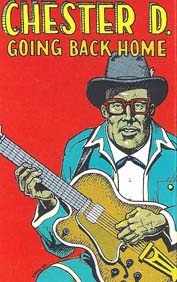
Going Back Home: Chester D and Spain

Chester D. Wilson, cover art
by Spain Rodriguez. 1989.
Back in the late 1980’s before South Beach was populated by AT&T Park, million dollar condos and fine eats, it was a light industrial and working class neighborhood. There was a dive bar called Bouncer’s around Townsend and 2nd, that served up cheap burgers and beer to the ironworkers in the area, and a big helping of local blues every night.

My ex-husband Chris played blues guitar, and we owned an indie record label, Blue Jazz Records, which was a labor of love, primarily supported by my day job at Winterland Productions. We recorded blues & jazz bands that played places that are long gone, like the Last Day Saloon, the Lost & Found, the Blue Lamp, or the upstairs bar at the Paradise Lounge. The “big-time” gigs were the Fillmore, Slim’s, The Calalyst in Santa Cruz or Doc Ricket’s Lab in Monterey.

Chester D. Wilson (video) was one of our artists. When we were introduced to him at Bouncer’s, he was a 73 year old retired construction worker, playing country blues in the style of Robert Johnson and Blind Lemon Jefferson.  It was Jefferson’s music that inspired Chester to build his own guitar as a young man and start playing juke joints around his hometown of Shreveport, Louisiana. One night at a dance, a white man shot him in the left hand. Chester would always explain that although a white man took away his ability to play then, a white man also took him to the hospital and made sure he was taken care of. “We are all just people,” he would say, “everybody’s good and bad.”

Chester moved with his father to work in the shipyards during WWII, and stayed in the Bay Area, working as a laborer and in construction. At the suggestion of Sonny Boy Holmes, an old friend, Chester taught himself to play the guitar left-handed. It took him a long time, but he was dedicated and began playing gigs again. After he retired, he started to play more regularly, and would play at the 24th and Mission BART station just to get out and stay in practice.

Chester at the Fillmore! Poster by
Whit Clifton (Wolfgang's Vault)
In 1989, we recorded him live to 2 track analog tape at Sound & Vision, a small studio south of Market. Most of the songs were solo, with occasional backup from Peter Chase on blues harp and Gary Bergman on rhythm guitar (Waterfront Blues Band). We included short interview segments between the songs, so people could hear Chester's story in his own words. When we started talking about cover art, he said that he’d met an artist while playing at the BART station that promised him a drawing. So that’s how we got a beautiful portrait of Chester by Spain Rodriguez for the cover. At the time, we could only afford to release the album on cassette, giving half the batch to Chester to sell at his gigs. He loved Spain's art, and Spain gave him the cover drawing as a gift.

Around the time we were working with him, Chester had some fun gigs. He opened for Johnny Winter and John Mayall at the Fillmore, and he played the SF Blues Festival at Fort Mason. "All my songs are true," Chester said in 1989. "They are about traveling, mean-hearted women and tough times. With the death of legends in the Blues like Muddy Waters and Lighting Hopkins, there's not many left who play our style of the Blues anymore."

In the turmoil of my divorce and subsequent moving around, I lost track of Chester, the original tapes, and the mechanical of the cover art. If he’s still around, he would be in his 90’s now. I was honored to know him.

PDF of BAM Magazine review/interview and cover F&B | YouTube video 1990.