Introductory video from Comics Unmasked: Art and Anarchy in the UK curated by Paul Gravett and John Harris Dunning, which just closed at the British Library. As usual, the catalog is the artifact that remains, and it's a beauty.
Thursday, August 21, 2014
Video: Comics Unmasked
Introductory video from Comics Unmasked: Art and Anarchy in the UK curated by Paul Gravett and John Harris Dunning, which just closed at the British Library. As usual, the catalog is the artifact that remains, and it's a beauty.


Comic Art, Creativity and the Law: Video Review
We were thrilled to see this thoughtful and detailed review of Marc's new book, Comic Art, Creativity and the Law from UK Barrister Phillip Taylor MBE of Richmond Green Chambers.
Other reviews: The 1709 Blog | Art and Artifice | ICv2
Critical Insights: The American Comic Book
 |
| CI: TACB Cover |
I also contributed entries on Mort Walker and Beetle Bailey to the newly released 4 volume set from ABC-CLIO Greenwood Comics Through Time, which explores creators, titles and themes of importance from decade to decade.
Saturday, August 9, 2014
SDCC 2014 - Panel Roundup
 |
| San Diego Convention Center. The white tents are
protecting the hours long line to get into Hall H from the blazing sun. Photo by Kim Munson. |
At the Future of Geek panel moderated by John Siuntres (Word Balloon podcast), Heidi MacDonald (The Beat), Rob Salkowitz (Comic-Con and the Business of Pop Culture) and Tim Beyers (Motley Fool) expert industry watchers talked about the sudden increase of comics conventions around the country, and what this means to the comics industry.This was a fascinating panel, and a recording of it is available on the Word Balloon site.
 |
| Future of Geek: Siuntres, Salkowitz, MacDonald and Beyers, with an unknown but helpful tech guy standing behind. Photo by Kim Munson. |
This year marked the 60th anniversary of the publication of Dr. Fredrick Wertham's infamous book Seduction of the Innocent, which provided an occasion to look back on an era of censorship that strangled the comics industry. The panel Sixty Years of Seduction: Rights, Wrong, and Wertham, hosted by Jeff Trexler (the Beat), managed a large and interested audience, despite a late Friday night time slot. Scenes from Sequart's new documentary about Wertham, Diagram for Delinquents (above) were shown by its director Robert A. Emmons, Jr, who was joined by Brandford W. Wright (Comic Book Nation), Carol Tilley (University of Illinois at Urbana-Champaign), and two psychiatrists, Vasilis K. Pozios, MD and Praveen R. Kambam, MD. The panel discussed Wertham's history and influences, his methodology, his campaign against comics and his legacy. A lively discussion about comics and violence followed. This panel is available almost verbatim on Bleeding Cool.
 | |
| Wertham experts: Trexler, Emmons, Wright, Tilley, Kambam and Pozios. Photo by Kim Munson. |
 |
| JMS presents new projects. Photo by Kim Munson. |
I'm always happy to add fun pages to our ever growing collection! This year I bought a great page from "The Slobbit" a MAD Magazine spoof drawn by Tom Richmond. That's the devious and dangerous dragon Smaug in the nose and glasses. Richmond was very nice, and was sitting at the National Cartoonist Society booth with Greg Evans, and his daughter Karen, the real Luann.
 |
| MAD's Tom Richmond. Photo by Kim Munson. |
 |
| Cover Story: Moderator Evanier, with artists Connor, Staples, Brooks, Lee and Sakai. Photo by Kim Munson. |
SDCC 2014 - CAC panels, Greenberg & Batman
As usual, the Comic Arts Conference, an academic conference within and in conjunction with San Diego Comic-Con International, offered a heaping platter of scholarly goodness. Several panels and presentations really stood out to me this year.
 Marc Greenberg, author of Comic Art, Creativity and the Law (my husband) and Rob Salkowitz, author of Comic-Con and the Business of Pop Culture, talked about what the potential future of comics might look like, and the legal complexities of the models they identified. They discussed corporate comics, indie comics, crowd funding, retail and digital sales, and many other topics, based on the four projections laid out in Rob's book and continued in Marc's.
It seemed to me that all four concepts have been happening simultaneously: the "Endless Summer" scenario, in which major corporations maximize the possibilities of their intellectual property and their audience; "Ghost World," in which the audience tires of the mainstream, and artists and indie publishers succeed in offering grassroots alternatives; "Infinite Crisis," in which a passionate but dwindling pool of fans and collectors support specialty retail, and the "Expanding Multiverse," in which a more diverse and global creator population harness the web, mobile, games and other platforms to tell their stories.
Following Marc and Rob's panel was a brilliant panel on British Comics, many unique to the UK titles like Misty, Doctor Who, and Judge Dread, and how their Golden Age comics borrowed (or outright copied) elements and characters from popular US comics.
Down on the exhibit floor, CAC regular Trina Robbins was at the Fantagraphics booth signing Pretty in Ink, her ultimate take on the "herstory" of women cartoonists. One of Trina's finest moments was her rediscovery of Lily Renee, an influential cartoonist of the WW2 era with an amazing story (read The Golden Age of Lily Renee here). Lily, who is 91, flew in from New York for a day of signing at the booth.
I enjoyed a presentation on Bill Hume's Babysan comics by historian R.C. Harvey and the final wrap-up panel of presentations by students of Matthew J. Smith on fan studies and marketing. Most of these students had never been to SDCC before, and it is always interesting to see the convention anew through their observations.
There were many panels and displays celebrating the 75th anniversary of the publication of Batman. Dean Trippe, author of Something Terrible spoke with Tommy Cash about how reading Batman rescued him from the mental anguish of childhood abuse (one page version here, you can buy the entire comic for 99 cents).
On the all-star panel Who Created Batman?, scholars and family representatives had a lively debate over who actually did create Batman, presenting panel art from Golden Age comics, research and anecdotal evidence to try to piece together how much of the creation of Batman could be attributed to Bob Kane, and how much to his collaborators Bill Finger and Jerry Robinson. To the surprise of no one, the conclusion was that Kane's claim of total ownership was probably exaggerated, and that Finger was the real brains behind the operation, joined later by Robinson. Panelists included Moderator Travis Langley (Henderson State University); Nicky Wheeler-Nicholson (granddaughter of the original founder of DC Comics); Tom Andrae (Batman and Me); Athena Finger (Bill Finger estate); Marc Tyler Nobleman (Bill the Boy Wonder); Denny O'Neil (Batman); Brad Ricca (Super Boys); Jens Robinson (CartoonArts International); Arlen Schumer (arlenschumer.com) and Michael Uslan (Dark Knight film trilogy).
Down on the exhibit floor, DC had a huge Batman display that included cases of props from the films and a fascinating art project with Bat themed art painted on capes.


It seemed to me that all four concepts have been happening simultaneously: the "Endless Summer" scenario, in which major corporations maximize the possibilities of their intellectual property and their audience; "Ghost World," in which the audience tires of the mainstream, and artists and indie publishers succeed in offering grassroots alternatives; "Infinite Crisis," in which a passionate but dwindling pool of fans and collectors support specialty retail, and the "Expanding Multiverse," in which a more diverse and global creator population harness the web, mobile, games and other platforms to tell their stories.
 | |
| Rob Salkowitz and Marc Greenberg after their panel. Photo by Kim Munson. |
 |
| British Comics: Julia Round presents as Pete Coogan, Chris Murray and Phillip Vaughan look on. Photo by Kim Munson. |
 |
| Lily Renee and Trina Robbins at the Fantagraphics booth. Photo by Marc Greenberg. |
There were many panels and displays celebrating the 75th anniversary of the publication of Batman. Dean Trippe, author of Something Terrible spoke with Tommy Cash about how reading Batman rescued him from the mental anguish of childhood abuse (one page version here, you can buy the entire comic for 99 cents).
 |
| Cover graphic from Dean Trippe's Something Terrible. |
 |
| Here's a blurry photo of the whole tribe at the Who Created Batman? panel. Photo by Kim Munson. |
Down on the exhibit floor, DC had a huge Batman display that included cases of props from the films and a fascinating art project with Bat themed art painted on capes.
 |
| DC Batman 75th Anniversary display at SDCC 2014. Photos by Kim Munson. |
Friday, August 1, 2014
Pretty in Ink at Cartoon Art Museum
 |
| Trina Robbins discusses the fine points of a page by Grace Drayton
from her collection at the Pretty in Ink exhibition, as CAM executive director Summerlea Kashar looks on. |
 | |||
| Trina Robbins pointing out highlights in the career of the flapper age cartoonist Nell Brinkley. |
In the next gallery was an exhibit of the work of Mike Zeck, an artist most identified with The Punisher, who also had popular runs on Captain America, Secret Wars, Lobo, GI Joe, Green Lantern, Batman, Master of Kung Fu, and Spider-man.

 |
| Art by Mike Zeck on display at the Cartoon Art Museum (through 8/10) |
Monday, July 21, 2014
Giacomo Patri - White Collar: A Novel in Linocuts
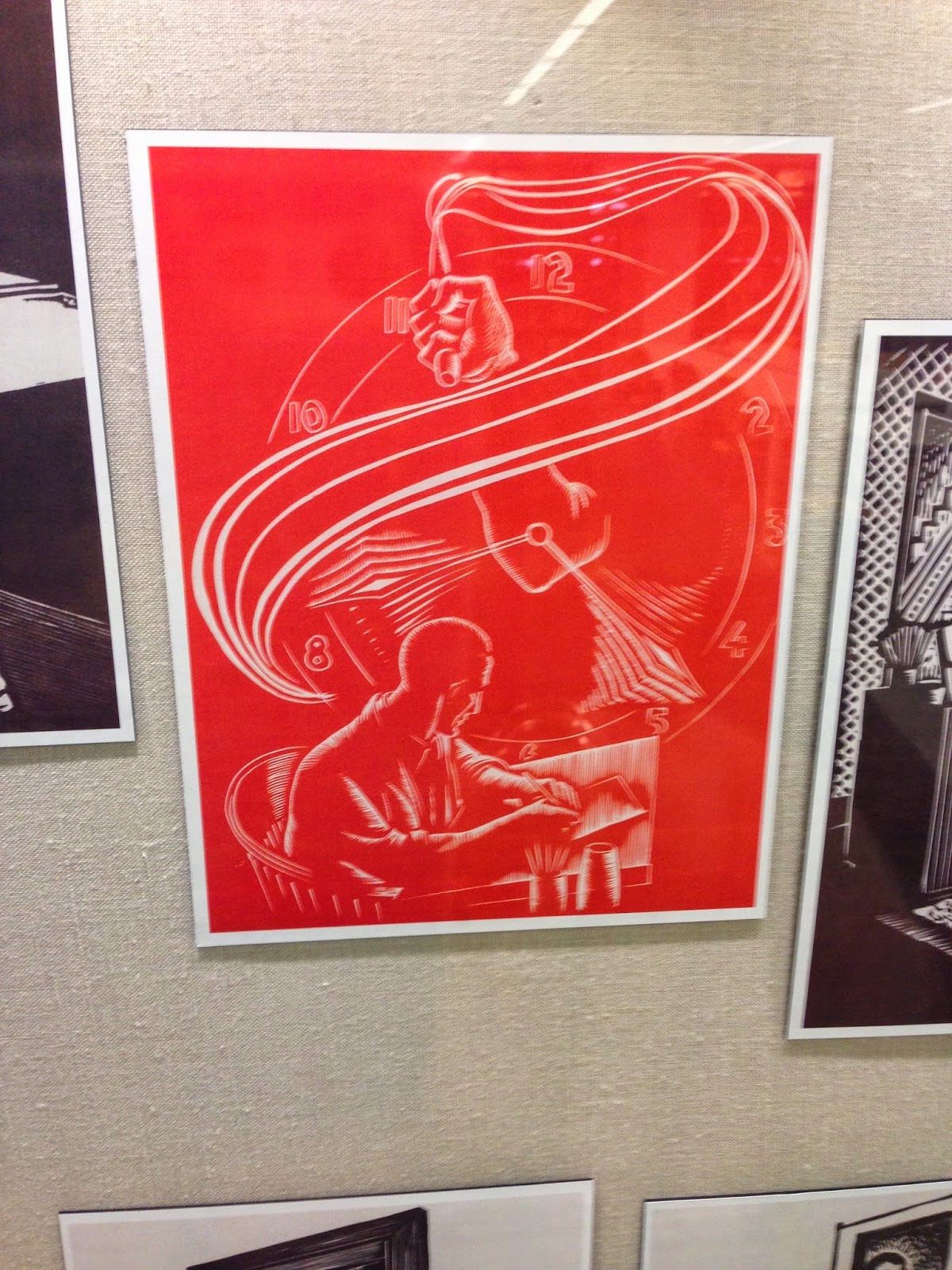
The Labor Archive and Research Center at the SFSU J. Paul Leonard Library has a display of the long out of print 1940 book White Collar: A Novel in Linocuts by Giacomo Patri (1898–1978), which is illustrated with linocut prints in two colors. The first edition of this wordless volume was hand printed by Patri and bound with his wife's assistance, two other editions were commercially printed.
Patri was born in Italy. Frustrated with a series of unfulfilling jobs, he went to night school to learn to be an artist. He worked in different capacities for 3 bay area newspapers, The San Francisco Examiner, The Call-Bulletin, and The San Francisco Chronicle. In the WWII era, he began teaching at the California Labor School and became the head of the Art Dept, while also doing freelance work for unions. After the Labor School was closed during the Red Scare in 1957, he had his own art school and kept freelancing until he retired in 1966.
The story follows the life of a mid-level advertising executive who suffers joblessness and tragedy after the 1929 stock market crash. Patri saw that white collar workers considered themselves professionals who saw no benefit from the union protections earned by blue collar workers, so they frequently shunned organizing campaigns and union activity. In the book Patri contrasts the isolation of the white collar worker trying to solve his own problems in isolation with the activity of the collective, eventually resulting in the white collar worker joining in united action. Here is a blog post with very clear scans.
The photos below are cell snaps of the exhibit in 4 cases on the 4th floor of the library.




Patri was born in Italy. Frustrated with a series of unfulfilling jobs, he went to night school to learn to be an artist. He worked in different capacities for 3 bay area newspapers, The San Francisco Examiner, The Call-Bulletin, and The San Francisco Chronicle. In the WWII era, he began teaching at the California Labor School and became the head of the Art Dept, while also doing freelance work for unions. After the Labor School was closed during the Red Scare in 1957, he had his own art school and kept freelancing until he retired in 1966.
The story follows the life of a mid-level advertising executive who suffers joblessness and tragedy after the 1929 stock market crash. Patri saw that white collar workers considered themselves professionals who saw no benefit from the union protections earned by blue collar workers, so they frequently shunned organizing campaigns and union activity. In the book Patri contrasts the isolation of the white collar worker trying to solve his own problems in isolation with the activity of the collective, eventually resulting in the white collar worker joining in united action. Here is a blog post with very clear scans.
The photos below are cell snaps of the exhibit in 4 cases on the 4th floor of the library.
Subscribe to:
Posts (Atom)